dailynewsnblog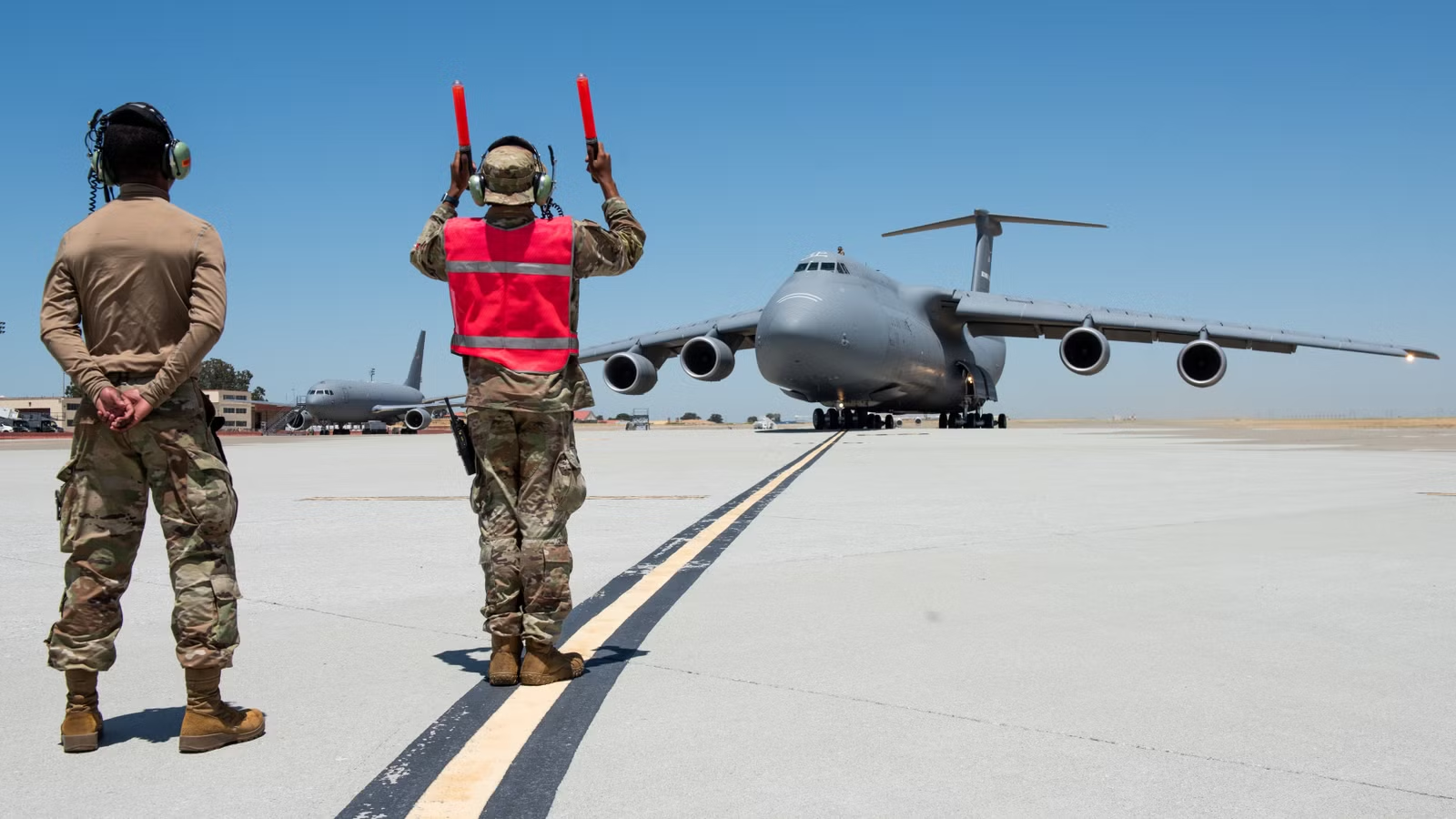
The United States Air Force (USAF) operates some of the largest aircraft in the world, although not the largest. The largest aircraft in US Air Force service are a mixture of purpose-built military aircraft, like bombers, and military versions of civilian aircraft, like the Boeing 747 Jumbo. The largest aircraft in the world today is the civil Airbus A380 Superjumbo. However, that is not in US Air Force service, and since the destruction of the Antonov An-225 Mriya, the world’s largest dedicated military aircraft is the Ukrainian/Russian Antonov An-124 Ruslan.
So while the US Air Force doesn’t operate any aircraft larger than the largest commercial aircraft, it does operate aircraft much larger than the typical Boeing 737 or Airbus A320 narrowbody. The Air Force also operates derivatives of the Boeing 747, 707, 767, 757, and 737. In the US, most of the commercial passenger aircraft are narrowbody Boeing 737s and Airbus A320s. As a benchmark, the popular Boeing 737 MAX 8 commercial airliner has a length of 129 feet and eight inches (39.5 meters) in length, a wingspan of 117 feet (35.9 meters), an MTOW of 182,200 lbs, and a thrust of 57,380 lbf.
5
Boeing B-52H Stratofortress
159 feet in length

While the KC-46 Pegasus (Boeing 767) is seven feet longer than the B-52, this list will give fifth place to the B-52 as the largest bomber in service and in recognition of being a dedicated military aircraft. The B-52 “BUFF” is one of the oldest platforms in active service with the US Air Force, even more so when the airframes themselves are considered. The B-52s were built between 1952 and 1962, meaning that the youngest airframes are now 64 years old. The US Air Force is planning to upgrade these massive strategic bombers and keep them flying into the 2050s and perhaps beyond. This will give them a chance to see 100 years of service.
The B-52s have an empty weight of around 185,000 lbs, which makes them a little lighter than the US’s other very heavy bomber, the Rockwell B-1B Lancer at 192,000 lbs. However, the B-52 is longer at 159 feet and four inches (48.5 meters) compared with the Lancer’s 146 feet (44.5 meters). The B-52H is also very similar to the B-1B, with MTOW at around 488,000 lbs to the B-1B’s 477,000 lbs. The flying-wing Northrop B-2 Spirit, and its B-21 Raider successor, are smaller than these older, nonstealthy aircraft.
All of the Air Force’s remaining B-52s are the B-52H variant, which was the final new-built variant. These are set to be upgraded to the B-52J variant and will be retrofitted with new Rolls-Royce BR700 (Rolls-Royce F130) turbofans. Those RR engines are comparatively small turbofans typically found on business jets; they can power the massive B-52 because it carries a whopping eight engines. The Air Force plans to retire its worn-out B-1Bs and its expensive B-2s as the B-21 becomes available in large enough numbers. The B-52 will operate as a missile truck operating with standoff munitions (including hypersonic missiles), while the B-21 carries out precision penetration missions.
4
Boeing C-17 Globemaster III
174 feet in length

The C-17 Globemaster III is the backbone of the US Air Force’s intercontinental airborne logistics. The Globemaster first entered service in 1995, and unlike the Galaxy, it was exported to a number of US allies and partners, including Australia, Canada, India, Kuwait, Qatar, the UAE, and the UK. Even so, the bulk (223) of the world’s 279 Globemasters were procured by the US Air Force. Due to remaining export demand, Boeing is considering putting the Globemaster back into production, although it now competes with the smaller Airbus A400M Atlas to some degree.
The C-17 has an empty weight of around 282,500 lbs, which is around 100,000 lbs less than its larger C-5M counterpart. It has an MTOW of around 585,000 lbs, making it considerably less than the C-5M’s 840,000 lbs. The Globemaster measures 174 feet long (53 meters) and 169 feet and ten inches (51.8 meters) in wingspan. PW2000 turbofans supply it with around 161,760 lbf. Compared with early transport aircraft, today’s military transport aircraft rarely crash, at least compared with the 1960s and 1970s. Only one US Air Force C-17 has been lost to an air crash.
It’s worth noting that if this article had been written a couple of years ago, then the fourth spot on this list would have gone to the McDonnell Douglas KC-10 Extender, which was based on the three-engine DC-10 airliner. However, these were retired by the Air Force in September 2024. The KC-10 is 181 feet seven inches (55.4 meters) long, making it longer than the C-17. The Air Force’s remaining tankers, the KC-135 and KC-46, are 136 feet and 165 feet long, respectively.

Lockheed C-5 Galaxy: Inside The Largest US Military Transport Aircraft Ever Constructed
The C-5M Super Galaxy serves a critical role in the US Air Force logistics around the world.
3
Boeing 747-200
231 feet in length

The Boeing 747-200 has lived an epic life, a life that is swiftly coming to an end as the remaining aircraft are in their twilight years. Rolls-Royce even retired its iconic 747-200 testbed aircraft in 2025. The US Air Force currently operates six examples of the Boeing 747 as the VC-25A “Air Force One” VIP aircraft and the E-4 Nightwatch “Doomsday” aircraft. Both of these aircraft are based on the aging Boeing 747-200 variant that has been largely retired elsewhere in the world.
Compared with the original 747-100, the Boeing 747-200 came with increased payload, more powerful engines, increased MTOW, and other improvements. Boeing produced a total of 393 examples with production ending in 1991. Up to 15 Boeing 747-200s remain in service around the world, of which a couple may have been destroyed in airstrikes in Iran during the 2026 campaign. This leaves the US Air Force operating around half of the world’s remaining 747-200 fleet.
The 747-200 comes with an empty weight of around 400,000 and an MTOW of around 833,000 lbs. The examples in US Air Force service were powered by four GE CF6 turbofans that provide a combined 210,000 lbf for the E-4B and 227,000 lbf for the VC-25A (they have different subvariants). They have a wingspan of 195 feet and eight inches (59.6 meters) and a length of over 231 feet (70.5 meters).

The 4 Largest Bomber Fleets In The US Air Force
A closer look at some of the biggest warbirds in America.
2
C-5M Super Galaxy
247 feet in length

The Lockheed C-5M Super Galaxy is famously the largest airlifter aircraft in US Air Force service. It was developed in the 1960s and was revolutionary for being powered by the new General Electric TF39 turbofans. The Air Force went on to produce 81 examples of the base C-5A variant and 50 examples of the upgraded C-5B variant for a total of 131 airframes. All, except for two original C-5As, have been retired or written off, while all of the C-5Bs remain in service.
These have been upgraded to the current C-5M Super Galaxy variant. As stated, the An-124 is the only dedicated military transport aircraft larger than the C-5M. The C-5M comes with an empty weight of around 380,000 lbs and has an MTOW of 840,000 lbs. Regarding dimensions, its wingspan stretches 222 feet and nine inches (67.9 meters), and its length is 247 feet and one inch (75.3 meters). Its General Electric F138-100 turbofans are the military designation for the popular GE CF6 engines that provide it with a combined 204,000 lbf.
While these 52 C-5Ms provide the Air Force with a unique capability for its massive globe-trotting logistical needs, the true strategic airlifer workhorse is the smaller Boeing C-17 Globemaster III. As big as it is, the C-5M is not necessarily the largest aircraft operating in North America. The commercial Boeing 747-400 has a length of 231 feet and ten inches (70.7 meters), a wingspan of 211 feet and five inches (64.4), an MOTW of 875,000 lbs, and a combined thrust of 253,200 lbf. This means that until the US Air Force brings its 747-8s into service, commercial operators like Atlas Air currently operate larger aircraft than the US Air Force by some measures.
1
Boeing 747-8
250 feet in length

The United States Air Force skipped the popular Boeing 747-400 and is now gearing up to bring the final Boeing 747-8 into active service. These are replacing the six aging Boeing 747-200s used as the current Air Force One jets and Nightwatch. So far, the US Air Force has purchased five 747-8s to replace its two Air Force One aircraft. These include the two contracted new Boeing 747-8s being built and fitted by Boeing as the next-generation presidential transport aircraft.
The other three jets include the controversially donated ex-Qatari 747-8 being hurriedly converted as an interim measure to bridge the aging 747-200s and the delayed purpose-built Boeing aircraft. The Air Force One 747-200s are becoming expensive to operate and unreliable. The US Air Force has also purchased two ex-Lufthansa 747-8s for spares and training. These 747-8s will be the largest aircraft in the US Air Force.
The Boeing 747-8 is a larger aircraft than its older Boeing 747-200. It is stretched to 250 feet and two inches (76.3 meters), has a lengthened wingspan of 224 feet and five inches (68.4 meters), and a MTOW of 987,000 lbs. Empty, the 747-8 weighs around 485,300 lbs, and its upper deck is considerably lengthened. Its four GEnx-2B turbofans provide a combined thrust of 266,000 lbf.