dailynewsnblog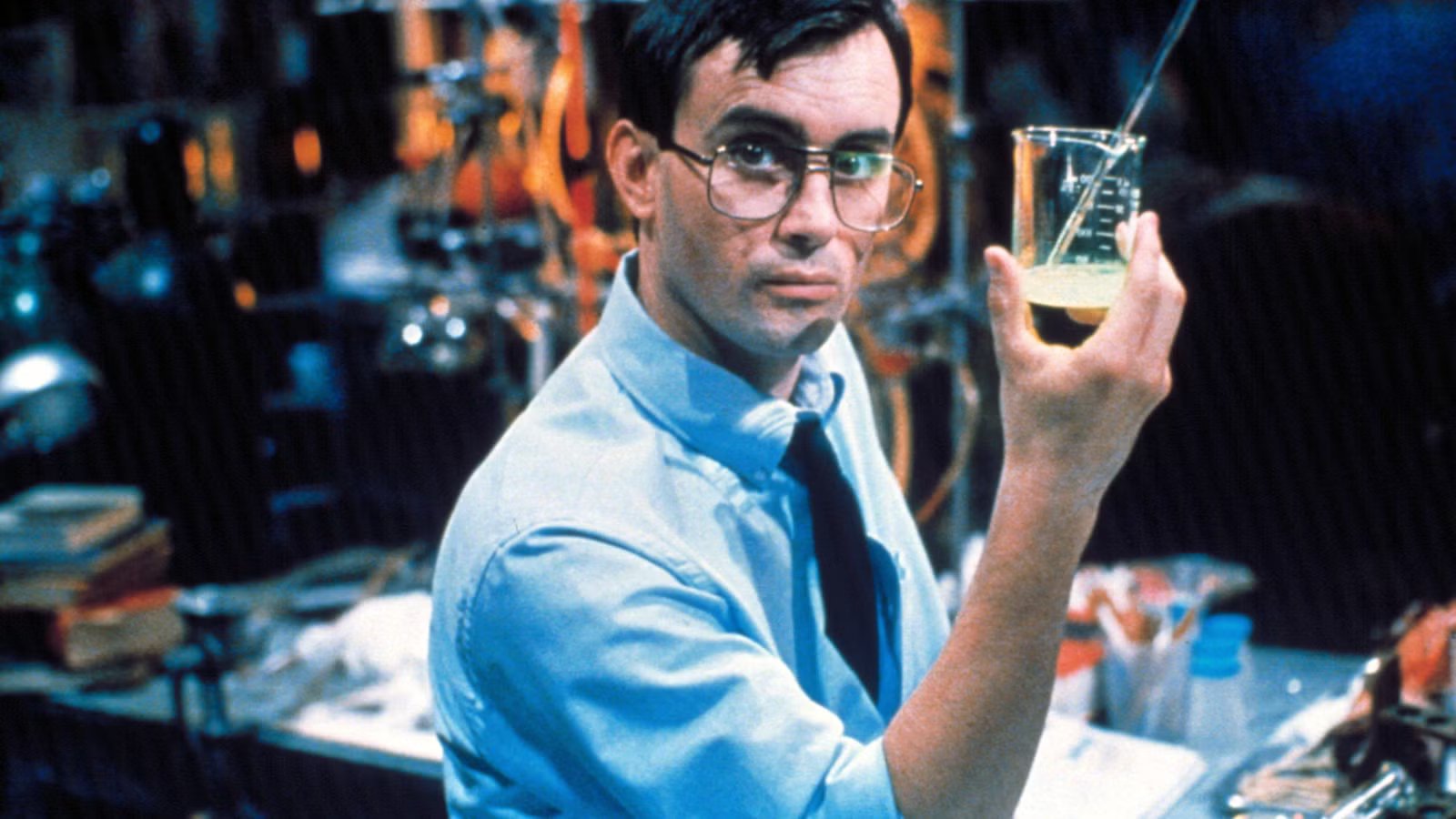
Campy excess is the name of the game in Stuart Gordon’s celebrated 1985 cult hit Re-Animator. His comedy-horror movie has all the hallmarks of a schlocky zombie movie, with tawdry special effects and a storyline that isn’t particularly original. This B-movie sensibility seems at odds with its source material, H.P. Lovecraft’s short story “Herbert West–Reanimator,” which paints a chilling picture of a brilliant mad scientist who pushes the limits of amorality. In Gordon’s film, Herbert West (Jeffrey Combs) is brash and impulsive, in spite of his clinically aloof nature. He’s obsessively dedicated to his mission to reanimate corpses. Brian Yuzna’s 1991 sequel, Bride of Re-Animator, keeps Herbert’s obsession alive, but this wacky follow-up lacks the innate charm of Gordon’s movie.
It’s been 35 years since Bride of Re-Animator’s direct-to-video release. (Re-Animator, by contrast, did reasonably well in theatrical release.) Yuzna was six years too late to capitalize on the hype surrounding its predecessor, which had already been mimicked by cult genre entries like Peter Jackson’s Braindead and Yuzna’s own directorial debut, Society. Bride of Re-Animator takes place eight months after the events of the first film, with Herbert (Combs) and his reluctant assistant, Dan Cain (Bruce Abbott), working as medics during the Peruvian civil war, which supplies them with plenty of corpses. The doctors use this supply of spare cadavers to test Herbert’s reanimation reagent, but their ghastly adventure is cut short when enemy troops storm their tent.
When they resume their experiments at Miskatonic University Hospital, Herbert shifts gears by attempting to use the reagent to create new life. This Frankensteinian impulse doesn’t sit well with Dan at all, as Herbert wants to use the heart of Dan’s dead fiancée, Megan (Barbara Crampton), who died in Re-Animator, for the experiment. Herbert manages to convince him, and the two end up creating the Bride (Kathleen Kinmont), with the reagent reanimating disparate body parts salvaged along the way.

But this scientific breakthrough is overshadowed by literal ghosts from the past. The re-reanimated severed (and now winged) head of Herbert’s former colleague, Dr. Carl Hill (David Gale), flies in, and a dozen zombies also break into their laboratory. The whys and hows behind these developments are unimportant: Yuzna is more interested in shocking us with oddities lovingly created with special effects, including a cluster of fingers attached to a single eyeball that scuttles around after being reanimated.
Possibly, Bride of Re-Animator’s only thematic complexity is reflected in the toxic, co-dependent bond between Herbert and Dan. The homoerotic undertones aren’t subtle: Herbert doesn’t really need Dan to succeed, as he’s already perfected the reagent, and his mind is one-track on accomplishing what he wants. If anything, Dan’s moral compass clashes with Herbert’s amorality, as the mad scientist doesn’t weigh his scientific curiosity against the scales of traditional good versus evil. But Herbert refuses to proceed without Dan’s involvement, insisting on a sense of domesticity by sharing a home that doubles as an experimental lab. He also refers to the neon fluid as “our” reagent — an uncharacteristic act for someone repeatedly defined by his professional arrogance.

But while the plot is simple to the point of being threadbare, the horror imagery can be breathtaking. Doublin FX’s Tony Doublin brought the special effects to life — the eyeball-finger creature, for instance, involved a stuntperson operating a rod puppet and stop-motion puppet at the same time. A similar approach was used to simulate the scene where a dog named Angel gets physically attached to a human arm.
Bride of Re-Animator ups the first movie’s gore factor with even more severed limbs, decaying cadavers, and bloodied, undulating masses of flesh. These crucial props were designed by Screaming Mad George, whose distinctive work shaped the aesthetic of films like Predator and The Abyss. As for Dr. Hill’s flying head, it was made by John Carl Buechler’s team at Magical Media Industries. Buechler’s skills as a special make-up effects artist have graced several horror entries, including A Nightmare on Elm Street 4: The Dream Master and Halloween 4: The Return of Michael Myers.

These artistic forces come together to flesh out Bride of Re-Animator’s unforgettable visual DNA — which was likely quite a challenge, since Yuzna’s film doesn’t achieve anything novel, and is mostly focused on furthering the in-your-face perversity of Gordon’s original. The writers threw in a couple of meandering subplots, and don’t make meaningful use of the titular character: The Bride disintegrates as easily as she is assembled. When the underlying pathos of the Bride’s short existence fails to make its mark, we’re drawn to the special effects used to portray her puppet-like body instead. The rest is a compelling explosion of splatter cinema, a term popularized by George A. Romero, who was describing his intensely violent Dawn of the Dead.
Bride of Re-Animator’s merits lie in Yuzna’s ability to make the most out of the central Dan-Herbert relationship, adding yet another layer of tragic symbiosis between the two scientists. When the duo is in their element, bickering softly about the quality of cadavers, or working closely to reanimate hacked-off limbs, the zany special effects tie everything together in a cathartic, gore-soaked bow.
Bride of Re-Animator is streaming free with ads on Tubi, and is available for digital rental or purchase on Amazon, YouTube, and other platforms.