dailynewsnblog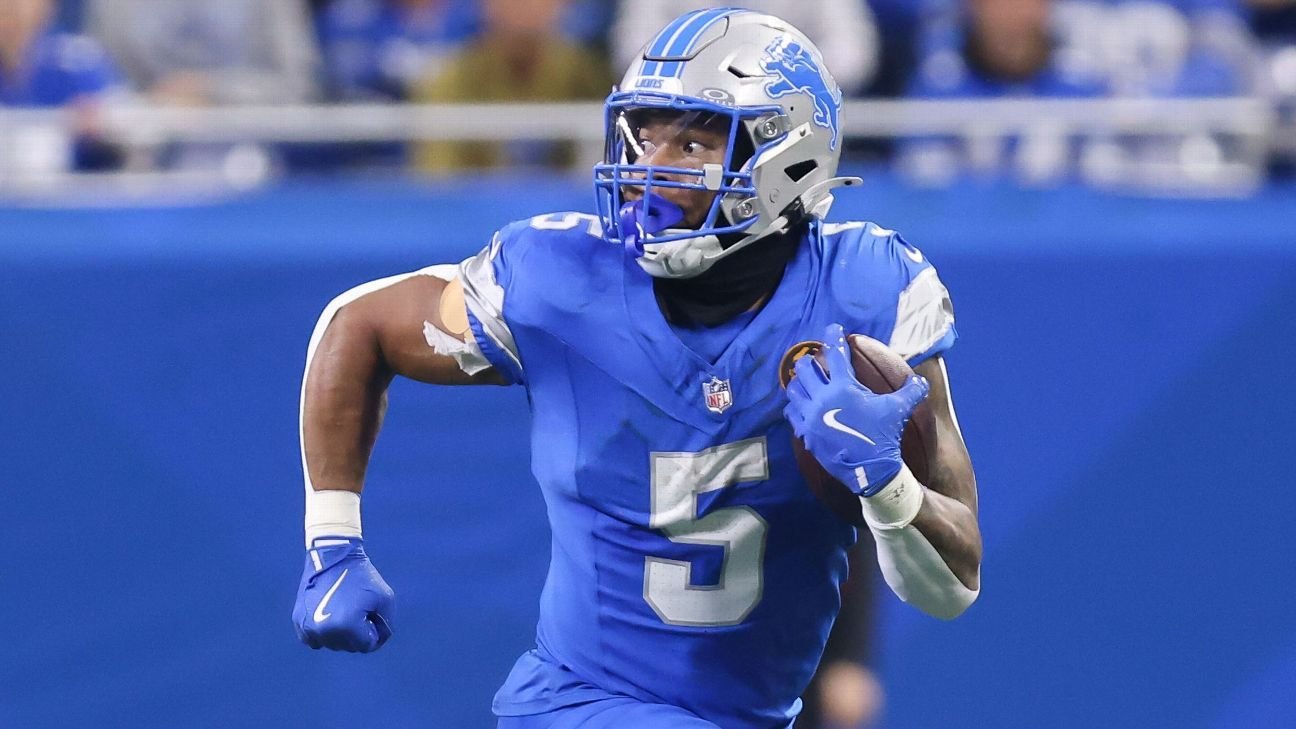
-

Seth Walder
Multiple Authors
NFL free agency begins March 9 with the legal negotiating window, but the action has already started. The Jets and Titans made the first big move of the offseason last week, with New York sending edge rusher Jermaine Johnson to Tennessee for defensive tackle T’Vondre Sweat. The Texans and Browns followed Monday, with Houston sending offensive tackle Tytus Howard to the Browns for a fifth-round pick. And the Lions made a surprising move later on Monday, trading running back David Montgomery to the Texans for guard Juice Scruggs and two draft picks.
ESPN analytics writer Seth Walder is grading the biggest signings and trades of the offseason, putting each deal into perspective for teams and players. To determine each grade, Walder is evaluating moves based on multiple factors, including on-field impact, salary cap implications, compensation, player value/age, and the context of a team’s short- and long-term outlooks. How large is the effect of this decision, and how sure are we it’s a good or bad choice? How does this affect a team’s chance to win the Super Bowl, this season or in the future?
Follow along as Walder evaluates and grades each move, with the most recent grades at the top. Let’s start with the Montgomery deal.
More coverage:
Top 50 free agents | Best free agent fits
Jump to a notable deal:
Montgomery-Scruggs | Howard
Johnson-Sweat



Texans get: RB David Montgomery
Lions get: G Juice Scruggs, 2026 fourth-round draft pick, 2027 seventh-round pick
Texans grade: D
Lions grade: A
At some point this offseason, the Texans needed to add a running back to team up with second-year man Woody Marks. They opted to do that early by acquiring Montgomery. Houston’s running game was abysmal in 2025, ranking 31st in EPA per designed carry. Their running back play wasn’t ideal, but the biggest culprit of that poor performance was an offensive line that ranked 32nd in run block win rate. Though Marks averaged only 3.6 yards per carry, he still recorded 31 rush yards over expected, another sign that the offensive line was the problem.
In Montgomery, the Texans acquire a reliable veteran who recorded 125 rush yards over expected with Detroit in 2025, per NFL Next Gen Stats. But his role has steadily decreased in recent years with the emergence of Jahmyr Gibbs. In the 14 games Montgomery played in 2023, he was featured on 48% of snaps and carried the ball 219 games. By 2025, those numbers dropped to 37% and 158, respectively, despite playing in 17 games. Montgomery’s receiving work was also limited because of Gibbs — as his 24 receptions last season where nowhere close to the 54 he once caught with the Bears in 2020.
Montgomery’s contract is reasonable: He’ll cost Houston $6 million in cash this year (and $9 million non-guaranteed next year) if left untouched. But that does not mean this was a smart acquisition. An aging (29 years old in June), early-down back whose prior team had been phasing out is not worth spending real resources on. It surprises me that Detroit was able to lure a four-seven swap here since they could have found comparable expected production for far less.
Scruggs is a reclamation project throw-in for Detroit. The 2023 second-round pick has bounced around the interior of Houston’s offensive line. At guard, he has been in the 24th and 26th percentiles in pass block win rate and run block win rate, respectively. The results at center in 2024 were even worse, as he was third percentile in both metrics. Scruggs has one year left on his rookie deal, but the draft picks should be more than enough here for the Lions. They can use that capital to find another running back to complement Gibbs late in the draft or find a low-cost veteran in free agency. It’s as easy a win as the Lions will find all offseason.

Browns get: OT Tytus Howard
Texans get: 2026 fifth-round pick
Browns grade: D+
Texans grade: A-
One starting offensive lineman down, four more to go for the Browns. In acquiring Howard, an offensive tackle who has occasionally kicked inside to guard in his seven NFL seasons, Cleveland starts the massive rebuild of its offensive line. But was it worth it? I have a hard time seeing how.
With six offensive line free agents, the Browns are going to look significantly different in the trenches in 2026, and they’re right to jump on this right away. There’s a good chance the Browns will have a young, developing player at quarterback — be it Shedeur Sanders or someone else — and it’s critical to keep that player upright.
Howard’s exact role is unknown due to his flexibility and how the Browns’ address their other holes upfront, but right tackle seems like the safest bet since it’s where he has most frequently played.
Howard ranked in the 24th percentile in pass block win rate at tackle and the 31st percentile in run block win rate at tackle last season. He was also below average in both in 2024. That hasn’t always been the case — Howard ranked in the top 10 overall in pass block win rate at tackle in 2021 and 2022. But we’re several seasons removed from that, and he scored poorly in run blocking in each of those seasons.
So the Browns are likely getting a below-average starter. And he isn’t cheap. Howard is slated to make $17.5 million in 2026 (the final year of his deal) and is now signing a two-year, $45 million extension, per ESPN’s Adam Schefter.
The Browns sat at less than $1 million under the 2026 cap prior to this deal, per OverTheCap.com, though their cap obligations lighten quite a bit in 2027. But is this where they want to spend their resources, dealing a fifth-round pick to pay what might be an over-market deal for a below-average starter? That’s not how I’d want to kick off the offseason.
This continues a recent pattern of offensive line turnover for the Texans, but I don’t mind this move for them. Houston needs better blocking, both to protect quarterback C.J. Stroud and generate a running game to support him. It was last in the NFL (32nd) in run block win rate, 30th in pass block win rate and 26th in yards gained before contact on running back rushes last season.
Howard played both right tackle and left guard for the Texans, who have plenty of open spots along the offensive line, with both Ed Ingram and Trent Brown set to be free agents. They’ll need to add offensive line help at some point and must set aside money to pay edge rusher Will Anderson Jr — and probably Stroud, too. So getting a fifth-round pick to not pay Howard seems like good business.


Jets get: DT T’Vondre Sweat
Titans get: Edge Jermaine Johnson
Jets grade: A-
Titans grade: C-
For all their faults, the Jets came out of last year’s trade deadline with two of the very best deals in that period. While hardly on the same scale, they kicked off the 2026 trade season with another shrewd move in swapping out Johnson for Sweat in a one-for-one swap.
The last of the Jets’ three 2022 first-round picks, Johnson put together one decent sack season in 2023, with 7.5 sacks en route to a Pro Bowl nod. That came while playing for current Titans head coach Robert Saleh, which I assume is a critical factor in why this deal was made.
But Johnson managed only 5.5 sacks over his other three seasons in New York, though he played just three games in 2024 due to an Achilles injury. Advanced pass-rushing metrics have not been kind to Johnson in his four-year career. His career pass rush win rate is only 8.4% (8.9% last season), while the average for a starting edge in that span is 15.6%.
Sweat, a 2024 second-round pick, has been a solid starting nose tackle for Tennessee. He should help the Jets’ run defense and provide some pass rush from the nose. While his 6.5% pass rush win rate at defensive tackle is below average for the position, it’s not bad considering where he lines up. He’ll join a Jets interior group that includes Harrison Phillips and Jowon Briggs.
As for Johnson, the Titans need help at edge. But that need doesn’t make it worth the cost.
Johnson is playing on his fifth-year option and will cost Tennessee $13.4 million, per OverTheCap. By contrast, Sweat has two years left on his rookie deal and will cost the Jets just $1.6 and $2.1 million in each of those years, respectively. Sweat is also younger and, in my view, has a better chance to be a plus contributor than Johnson. That makes this deal well worth it for New York, especially considering the Jets will get a player with another year of team control for less money.