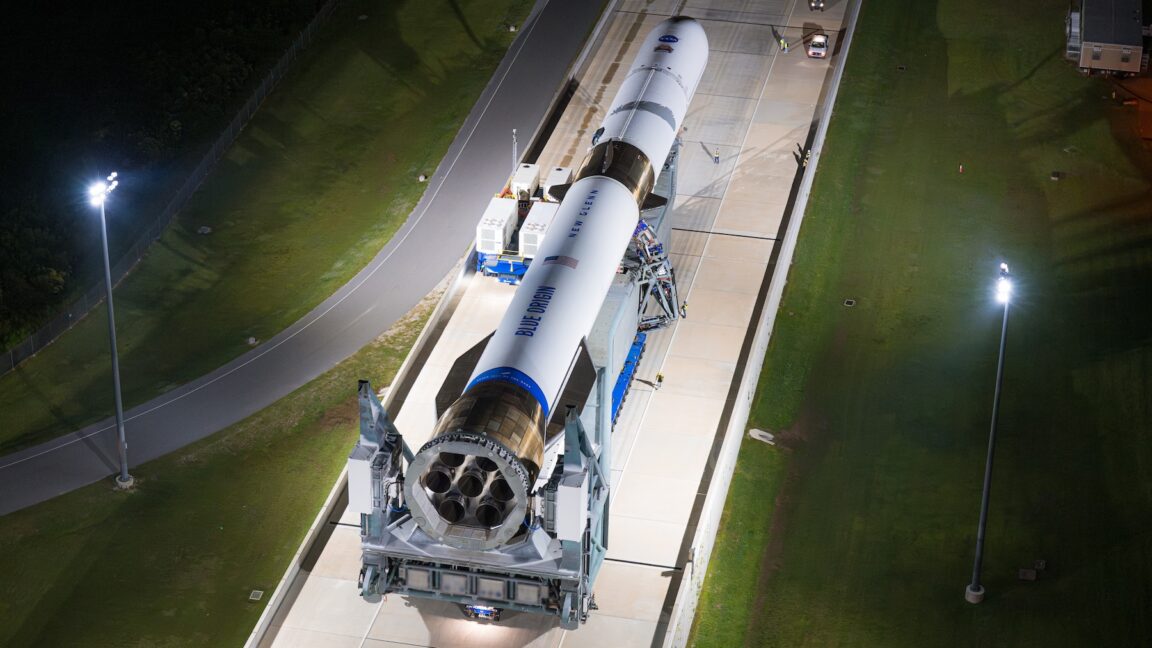
Google announced this week that it will employ Blue Origin’s New Glenn rocket to deliver the first batch of Project Suncatcher satellites into low‑Earth orbit, a move that aligns the tech giant with one of the newest heavy‑lift providers in the United States. The decision follows months of internal testing and a series of confidential briefings with Blue Origin executives, culminating in a formal contract that earmarks a launch window later in the calendar year from the Kennedy Space Center’s Launch Complex 36.
The mission is slated to lift approximately 30 Suncatcher satellites, each weighing roughly 250 kilograms, into an orbital plane optimized for high‑throughput broadband services over underserved regions. Blue Origin will handle integration, fueling, and flight operations, while Google retains responsibility for payload testing and on‑orbit commissioning. The partnership also includes a data‑sharing clause that allows both companies to analyze launch performance metrics for future iterations.
Google’s senior vice president for infrastructure, speaking at a virtual press briefing, emphasized that the New Glenn offers the payload capacity and reliability needed to accelerate the rollout of its next‑generation network. Blue Origin’s chief engineer echoed the sentiment, noting that the collaboration validates New Glenn’s commercial viability and underscores the growing demand for dedicated launch services among non‑traditional space actors.
In-Depth Analysis & Key Details
Project Suncatcher traces its roots to Google’s earlier efforts to build a global, low‑latency fiber network, a strategy that shifted toward satellite‑based connectivity as terrestrial infrastructure proved insufficient in remote locales. The pivot mirrors a broader industry trend where data‑centric firms seek to own the end‑to‑end delivery chain, from ground stations to orbital assets. Historically, the high cost of launch services has constrained such ambitions, but the emergence of reusable heavy‑lift rockets like New Glenn promises incremental cost reductions.
Regulators have closely monitored the partnership, with the FAA’s Office of Commercial Space Transportation issuing a launch license after reviewing environmental impact assessments and safety protocols. Meanwhile, policy analysts observe that the collaboration raises questions about market concentration, as a handful of launch providers begin to dominate access to orbit for commercial constellations. Economic models suggest that even modest improvements in launch price per kilogram could translate into billions of dollars saved across a multi‑year deployment schedule.
Industry observers note that Google’s choice of Blue Origin, rather than SpaceX’s Falcon 9 or the emerging Vulcan Centaur, signals a strategic diversification of launch options. This move may encourage competitive pricing and spur innovation among providers vying for large‑scale commercial contracts. However, experts caution that the underlying challenge remains: scaling a satellite fleet while maintaining launch cadence and managing orbital debris risk.
"Partnering with Blue Origin gives Google a viable lift option, but the underlying challenge of scaling satellite constellations remains unresolved."
Why This Matters & What Lies Ahead
For everyday internet users, the success of Project Suncatcher could mean faster, more reliable broadband in regions where fiber or cable networks are impractical, narrowing the digital divide that affects education, healthcare, and economic opportunity. From a market perspective, a reliable launch pipeline reduces capital exposure for Google’s satellite venture, potentially reshaping the competitive landscape against incumbents like SpaceX’s Starlink and Amazon’s Project Kuiper.
Stakeholders will watch the upcoming launch window closely, as the FAA’s post‑flight safety review and the International Telecommunication Union’s spectrum allocation hearings are scheduled for early next year. Additionally, congressional committees overseeing commercial space policy have signaled interest in hearings that examine the environmental and security implications of mega‑constellation deployments. These events will determine whether Google’s moonshot can transition from a technical demonstration to a sustainable commercial service.
Source: Reported by Ars Technica · Analyzed & Synthesized by DNB Newsroom


