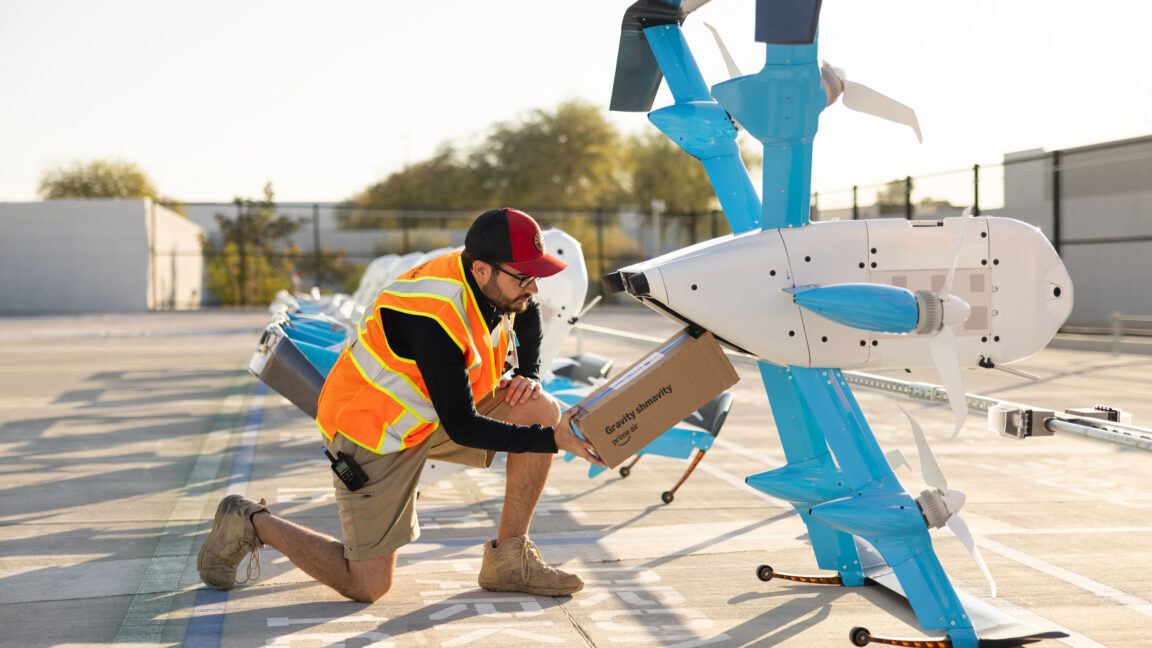
The Federal Aviation Administration announced on Tuesday that it is formally probing a recent accident involving an Amazon Prime Air delivery drone that struck an electrical conduit and crashed into a private garage in the Phoenix suburb of Glendale. The aircraft, part of Amazon’s expanding fleet of autonomous aerial couriers, was conducting a routine last‑mile drop‑off when it made contact with a low‑lying power line, causing the vehicle to lose lift and tumble onto the homeowner’s property.
The incident occurred in the early afternoon of June 21, 2026, during a test corridor that Amazon has designated for suburban deliveries in Arizona’s greater Phoenix area. Eyewitnesses reported a faint buzzing sound followed by a sudden thud as the drone descended onto the garage roof, shattering a portion of the structure and igniting a brief fire that was quickly extinguished by the occupants.
In a brief statement, FAA Administrator Mike Whitaker said the agency is “committed to ensuring that emerging aerial delivery systems meet the highest safety standards.” Amazon’s spokesperson, Lauren Mitchell, expressed regret over the event, emphasizing that the company “continues to prioritize safety and is cooperating fully with federal investigators.” Industry observers noted that the crash could serve as a watershed moment for the nascent sector, which has been racing to prove the viability of high‑volume, low‑cost drone logistics.
In-Depth Analysis & Key Details
The FAA’s decision to open a formal investigation reflects a broader regulatory evolution that began after the 2023 Federal Register notice requiring commercial unmanned aircraft systems to obtain airworthiness certificates for operations beyond visual line of sight. Since then, Amazon, Alphabet’s Wing, and several startups have pushed the envelope, arguing that the economic benefits of rapid, contactless delivery outweigh the perceived risks.
Critics, including aviation safety advocacy groups, argue that the rapid scaling of drone fleets has outpaced the development of robust obstacle‑avoidance sensors and real‑time air‑traffic management tools. The Glendale crash underscores a technical limitation: many current models rely on visual‑camera systems that can be confused by low‑contrast utility lines, especially under bright sunlight. Regulators are therefore debating whether mandatory radar‑based detection or mandatory geofencing around known infrastructure should become a prerequisite for commercial operations.
Industry analysts observe that the incident could accelerate the FAA’s push for a unified Unmanned Aircraft System Traffic Management (UTM) framework, a digital overlay designed to coordinate thousands of low‑altitude flights. If the agency mandates retrofitting existing drones with advanced lidar or radar sensors, manufacturers may face significant redesign costs, potentially delaying the projected 2028 nationwide rollout of autonomous delivery corridors.
"The Glendale accident is a stark reminder that scaling a new transportation modality without fully mastering its interaction with everyday infrastructure can jeopardize public trust and stall regulatory progress."
Why This Matters & What Lies Ahead
For consumers, the promise of sub‑hour deliveries hinges on the reliability and safety of autonomous drones navigating densely populated neighborhoods. A high‑profile crash erodes confidence, prompting shoppers to question whether the convenience outweighs the risk of property damage or, in worst‑case scenarios, personal injury. Moreover, insurers are closely monitoring the event, as claims stemming from drone‑related incidents could reshape premium structures for both operators and homeowners.
Legislators in several states have already introduced bills that would require local municipalities to approve drone flight paths and enforce stricter liability standards. The FAA’s investigation timeline, expected to culminate in a preliminary report by early 2027, will likely influence these proposals. Stakeholders will also be watching the upcoming Federal Aviation Administration Advisory Committee meeting in March 2027, where potential revisions to Part 107 regulations—governing commercial drone operations—are slated for discussion. The outcomes could set the tone for how quickly, and under what conditions, the industry can expand beyond pilot programs into full‑scale commercial service.
Source: Reported by Ars Technica · Analyzed & Synthesized by DNB Newsroom