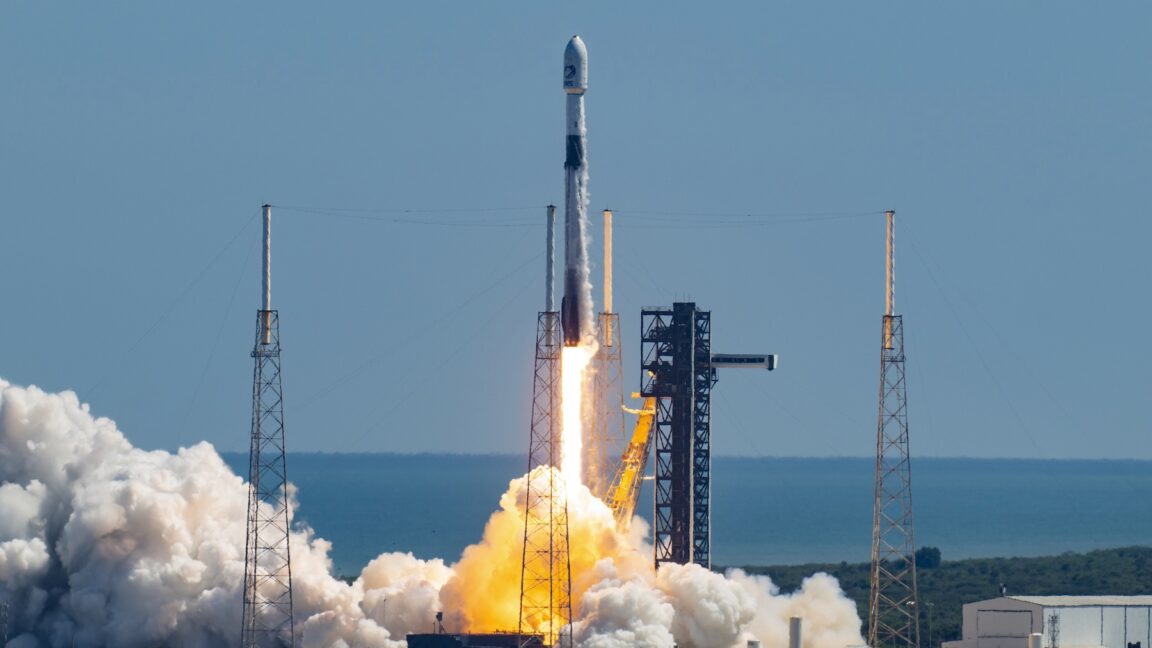
Amazon has formally intensified its procurement of launch services from SpaceX, a move directly precipitated by the inability of United Launch Alliance to reliably deliver the company's satellite payloads to orbit. The tech giant, which has invested billions in its Project Kuiper low-earth orbit broadband constellation, faces a mounting logistical crisis as its manufacturing pace outstrips its access to launch vehicles. Industry sources indicate that Amazon has shifted its primary launch strategy to secure more frequent flight opportunities with SpaceX, effectively sidelining ULA for a significant portion of its upcoming deployment schedule.
The operational context of this shift is defined by the sheer volume of hardware Amazon has already produced. Hundreds of Kuiper satellites are currently in storage, awaiting the next available launch window. These satellites have a finite operational lifespan and must be deployed within a specific timeframe to remain viable components of the constellation. The delay caused by ULA’s performance issues threatens to extend the period these assets sit in inventory, increasing exposure to physical degradation and regulatory scrutiny regarding timely deployment commitments made to the Federal Communications Commission.
While Amazon has not issued a detailed public statement outlining the specific contract changes, industry analysts observe that the company’s recent launch cadence reflects a clear prioritization of SpaceX’s Falcon 9 rockets. ULA, a joint venture between Lockheed Martin and Boeing, has faced mounting criticism for its launch reliability and cost structure in the face of SpaceX’s aggressive pricing and rapid turnaround times. Stakeholders in the commercial space sector view this realignment as a decisive vote of confidence in SpaceX’s ability to handle the high-volume, repetitive launch requirements of modern satellite constellations.
In-Depth Analysis & Key Details
The historical backdrop of this development reveals a fundamental shift in the economics of orbital access. For decades, the U.S. government and private sector relied on a limited number of launch providers, with ULA holding a dominant position following the merger of its parent companies. However, the entry of SpaceX into the commercial market disrupted this equilibrium, introducing reusable rocket technology that drastically reduced the cost per kilogram to orbit. As the demand for satellite constellations has exploded, the traditional launch model, characterized by long lead times and high per-launch costs, has struggled to keep pace with the manufacturing capabilities of companies like Amazon, Starlink, and OneWeb.
Competing perspectives within the industry highlight the tension between legacy infrastructure and new entrants. ULA advocates argue that its vehicles offer essential strategic redundancy and that the company is undergoing necessary upgrades to improve its competitiveness. Conversely, industry analysts observe that the market is increasingly bifurcating, with high-volume commercial customers gravitating toward SpaceX for its frequency and cost efficiency, while government and specialized missions continue to utilize ULA’s heavier-lift capabilities. This dynamic creates a competitive pressure that forces ULA to either accelerate its development of new launch systems or risk losing significant market share to its rivals.
From a technical standpoint, the deployment of large constellations requires a consistent and predictable launch cadence that is difficult to achieve with current ULA offerings. SpaceX’s ability to launch multiple times per week provides the flexibility needed to deploy satellites in batches, optimizing the use of launch windows and minimizing the time assets spend in storage. This operational efficiency is a critical factor for companies seeking to bring their services online quickly and compete in the global broadband market. The technical intricacies of satellite deployment, including orbital slotting and interference management, further underscore the importance of reliable and frequent launch access.
"The shift from sporadic government-backed launches to a commercial, high-frequency model is not just a logistical adjustment; it is a structural redefinition of who controls access to the final frontier."
Why This Matters & What Lies Ahead
For consumers and global supply chains, the timely deployment of Amazon’s Kuiper constellation is critical to expanding broadband access in underserved regions. Delays in launch can push back the availability of these services, impacting economic development and digital inclusion in rural and remote areas. Furthermore, the competitive dynamics between launch providers influence the overall cost structure of space-based services, which can have downstream effects on the pricing of internet connectivity and data services for businesses and individuals. The reliability of these launch services is also a matter of public interest, as it affects the safety and sustainability of the orbital environment, where increasing congestion poses risks to existing space assets.
Upcoming milestones to monitor include the next scheduled launch windows for both SpaceX and ULA, as well as any regulatory updates from the FCC regarding deployment timelines and spectrum usage. Investors and industry observers should also watch for announcements from ULA regarding new launch vehicle developments or partnerships that could alter the competitive landscape. Additionally, the performance of Amazon’s initial Kuiper satellites once in orbit will be a key indicator of the system’s viability and the effectiveness of the company’s launch strategy. These factors will collectively determine the pace at which new broadband services become available and the long-term stability of the commercial space market.
Source: Reported by Ars Technica · Analyzed & Synthesized by DNB Newsroom