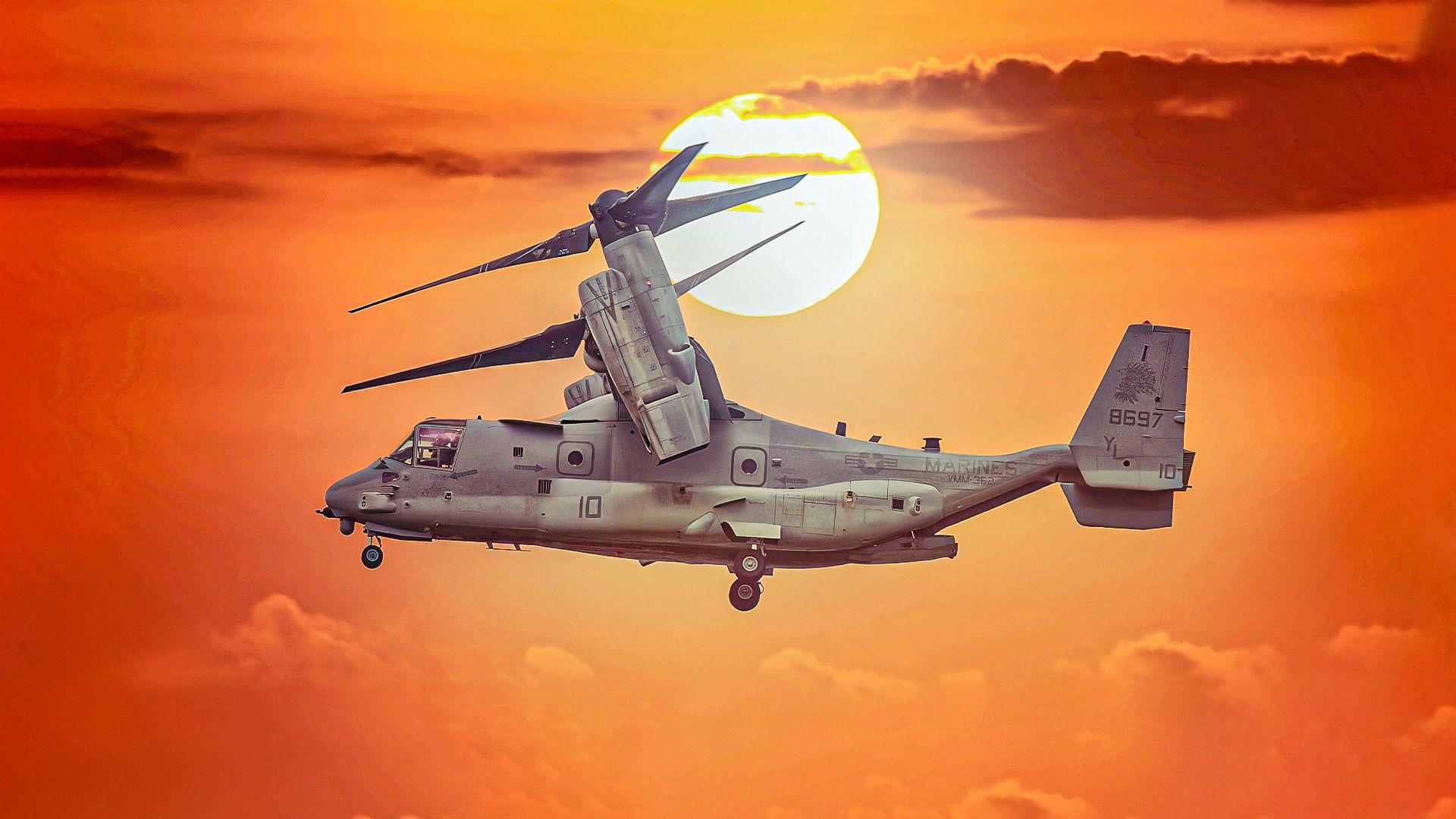
The Bell Boeing V-22 Osprey, a dual-role tiltrotor aircraft, faces a unique aerodynamic challenge that distinguishes it from both conventional helicopters and fixed-wing aircraft. Unlike a standard helicopter, which can hover at any speed, or a plane, which requires runway takeoff, the Osprey must execute a complex transition between these two flight regimes. This transition is not instantaneous but occurs within a carefully controlled speed range, where the rotors tilt from vertical to horizontal while the aircraft accelerates to airplane cruise speeds.
The operational context of this transition is critical for mission success and safety. Pilots must manage the aircraft's energy state meticulously, ensuring that the rotors generate sufficient lift to support the aircraft's weight while also producing forward thrust. This phase is often referred to as the 'transition regime,' where the aerodynamic forces acting on the aircraft are most complex and unpredictable. Any deviation from the established flight path or speed profile can lead to increased structural loads or loss of control authority.
Military aviation authorities and manufacturers have emphasized the importance of strict adherence to these operational guidelines. Official training manuals and flight data records highlight the need for precise coordination between the pilot, co-pilot, and onboard systems. Stakeholders, including defense procurement officials, have noted that while the Osprey offers unparalleled versatility, its operational complexity requires a higher level of pilot skill and maintenance rigor compared to traditional aircraft.
In-Depth Analysis & Key Details
The historical development of the V-22 Osprey was driven by the need for a versatile aircraft capable of both short takeoff and landing (STOL) and vertical takeoff and landing (VTOL). This dual capability introduced significant engineering challenges, particularly in managing the aerodynamic transition between helicopter and airplane flight. Early prototypes faced issues with rotor blade loading and control stability during transition, leading to extensive testing and design refinements. The current operational standards reflect decades of accumulated data and lessons learned from field operations.
From a regulatory and safety perspective, the transition regime is a focal point for accident investigation and safety improvements. The U.S. Army and Marine Corps have implemented additional training modules and simulation exercises to ensure pilots are proficient in managing this critical phase. Economic consequences of these safety measures include higher training costs and maintenance requirements, but these are justified by the reduced risk of catastrophic failures. Competing perspectives often debate the balance between operational flexibility and safety margins, with some arguing that the Osprey's complexity outweighs its benefits in certain scenarios.
Expert domain context reveals that the transition speed range is determined by a combination of aerodynamic principles, structural limits, and control system capabilities. Aerodynamic models show that at low speeds, the rotors act primarily as lift devices, while at high speeds, they function as thrust generators. The transition speed is the point where these roles overlap, requiring careful management to avoid excessive blade bending or loss of lift. Control systems must be tuned to respond quickly to changes in airspeed and rotor angle, ensuring stable flight throughout the transition.
"The V-22 Osprey's transition regime is a testament to the ingenuity required to merge helicopter and airplane flight, but it also underscores the unforgiving nature of aerodynamic limits that pilots must respect with precision."
Why This Matters & What Lies Ahead
For everyday readers and public policy, the operational constraints of the V-22 Osprey highlight the broader challenges of developing advanced aviation technologies. The need for precise speed control during transition affects mission planning, resource allocation, and safety protocols. This has implications for defense budgets, as maintaining a highly trained pilot corps and sophisticated maintenance infrastructure requires significant investment. Additionally, the Osprey's operational profile influences public perception of military aviation, with its unique capabilities often drawing attention to the complexities of modern warfare.
Upcoming milestones to watch include the rollout of new software updates for the Osprey's flight control system, which aim to further enhance stability during transition. Regulatory votes on the expansion of tiltrotor technology to civilian applications may also be on the horizon, with potential implications for urban air mobility and emergency response. Court dates related to ongoing safety investigations or procurement disputes could provide further insight into the regulatory landscape surrounding tiltrotor aircraft. These developments will shape the future of the Osprey and similar aircraft in both military and civilian sectors.
Source: Reported by Simple Flying · Analyzed & Synthesized by DNB Newsroom