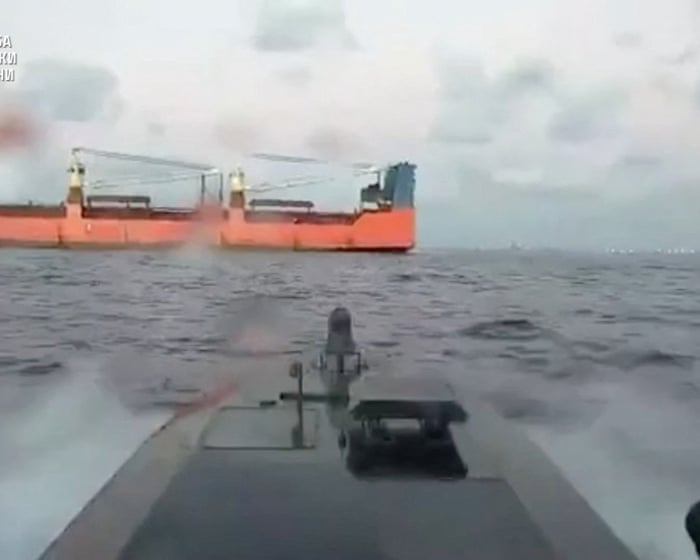
Ukraine's main intelligence agency announced that a covert operation involving unmanned surface vessels was carried out against Russian naval assets operating near the Libyan shoreline on Sunday, resulting in the loss of the corvette Merkury, a recently commissioned warship.
According to the agency, a total of seven self‑propelled drones were released from a larger support ship that functioned as a launch platform, striking two separate Russian vessels before retreating to international waters. The action took place in the eastern Mediterranean, an area where Russian warships have maintained a persistent presence to support allied interests in Libya.
Ukrainian officials described the operation as a defensive response to perceived Russian aggression in the region, while Russian authorities have not yet issued an official comment, though state media hinted at a “temporary setback” for their fleet. International observers are monitoring the incident for its implications on maritime security and the evolving use of unmanned combat systems.
In-Depth Analysis & Key Details
The deployment of naval drones reflects a broader shift in Ukraine's asymmetrical warfare strategy, which has increasingly relied on remote‑operated and autonomous technologies since the 2022 invasion. Historically, Ukraine's naval capabilities were limited to a small fleet in the Black Sea, but the conflict has spurred rapid innovation and the adaptation of commercial drone technology for maritime strike roles.
From a geopolitical standpoint, the Mediterranean theater has become a flashpoint where Russian naval logistics intersect with Western interests, especially as Russia backs the Libyan Government of National Accord. The strike underscores the tension between Russia's desire to project power far from its home ports and NATO's commitment to safeguard sea lanes, prompting diplomatic dialogues about rules of engagement for unmanned vessels in international waters.
Defense analysts note that the successful sinking of a modern corvette signals a maturation of Ukraine's drone command‑and‑control infrastructure, suggesting that similar unmanned platforms could be fielded in other maritime domains. However, the lack of clear legal frameworks for autonomous weapons at sea raises concerns about escalation and attribution, prompting calls for clearer international guidelines.
"The loss of Merkury illustrates how unmanned maritime systems can alter the balance of naval power, turning a modest drone fleet into a strategic lever in a high‑stakes conflict."
Why This Matters & What Lies Ahead
For ordinary citizens and global markets, the incident highlights the growing vulnerability of conventional warships to low‑cost, high‑impact technologies, potentially reshaping naval procurement budgets and insurance premiums for commercial shipping routes that traverse the Mediterranean. Moreover, the strike may influence energy markets, as both Russia and Western allies rely on the region's oil and gas transit points, and any disruption could reverberate through global prices.
Policymakers and legislators will be watching forthcoming discussions at NATO’s maritime security forum and upcoming UN meetings on autonomous weapons. The incident is likely to trigger reviews of existing maritime law, potential sanctions against entities supplying drone components, and heightened scrutiny of naval activities around Libya as the international community seeks to prevent further escalation.
Source: Reported by The Guardian · Analyzed & Synthesized by DNB Newsroom


