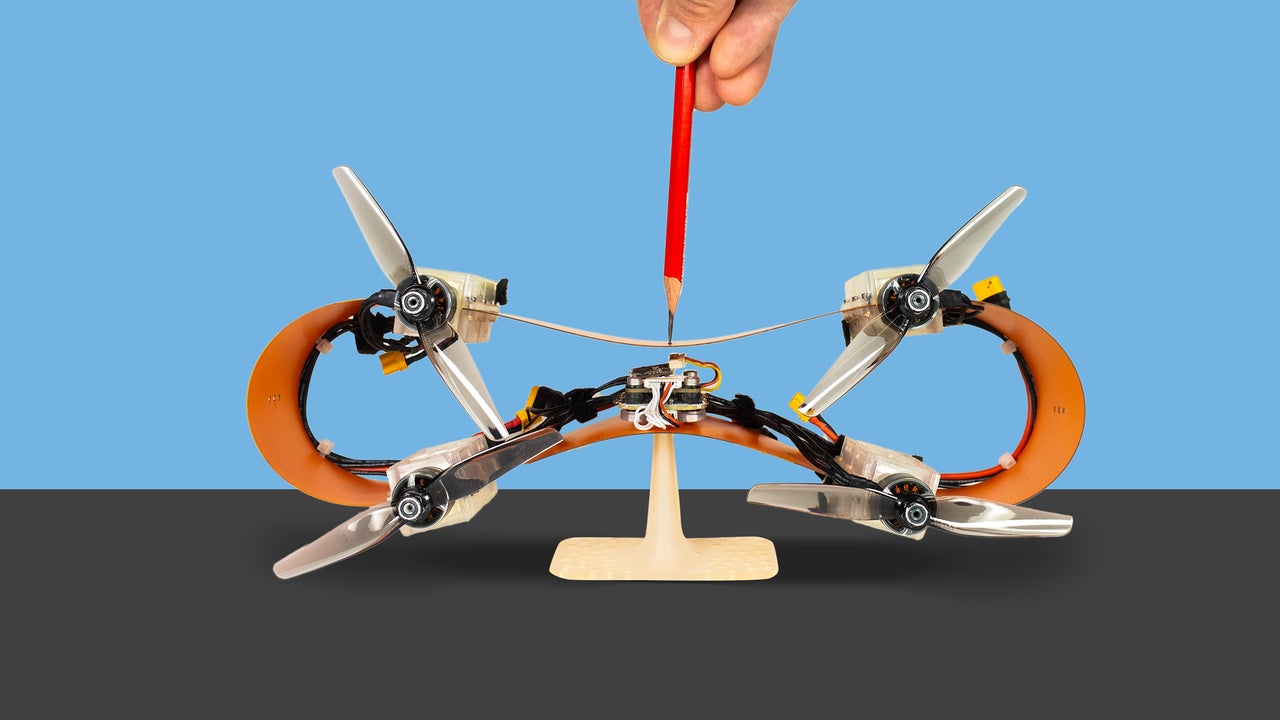
In a development that challenges the fragility of current aerial robotics, engineers have unveiled a quadcopter design capable of withstanding direct physical impacts with solid objects. The device, designated as FlexiQuad, was observed in controlled test scenarios colliding with tree trunks, a scenario that is fatal to the majority of existing drone architectures. Unlike standard carbon-fiber or plastic-framed drones that shatter or tumble uncontrollably upon impact, the FlexiQuad absorbed the force of the collision and resumed stable flight, marking a distinct leap in mechanical resilience for unmanned aerial vehicles.
The operational context of this demonstration highlights the specific vulnerability of current drone technology in non-geofenced environments. As the aviation industry pushes toward urban air mobility and autonomous logistics, the risk of collision with static infrastructure, vegetation, or other aircraft remains a primary concern. The FlexiQuad’s ability to 'bounce' back from an obstacle suggests a new paradigm where durability is not just about preventing crashes, but about surviving them without total system failure. This capability is particularly relevant for search-and-rescue missions in dense forests or infrastructure inspections in crowded industrial zones, where the likelihood of incidental contact is non-zero.
While the engineering team behind the FlexiQuad has not yet released a full white paper, initial observations indicate that the core innovation lies in the material composition and structural geometry of the airframe. Stakeholders in the drone industry have responded with cautious optimism, noting that while the concept is promising, the transition from a laboratory prototype to a commercial product faces significant hurdles in terms of weight-to-strength ratios and battery efficiency. The immediate reaction from aviation safety regulators has been to request detailed data on the energy absorption metrics to determine if such designs meet existing airworthiness standards for autonomous flight.
In-Depth Analysis & Key Details
The historical trajectory of drone design has prioritized lightweight construction and aerodynamic efficiency, often at the expense of structural robustness. Traditional quadcopters are engineered with rigid frames to minimize weight, as every gram of additional material directly impacts battery life and payload capacity. The FlexiQuad represents a counter-intuitive approach, leveraging flexible materials that can deform under stress and return to their original shape. This mirrors concepts seen in automotive crash safety and aerospace landing gear, but applied at a micro-scale for small unmanned vehicles. The structural forces at play involve the conversion of kinetic energy into elastic potential energy, preventing the high-frequency vibrations and shattering that typically destroy rigid drone components upon impact.
From a regulatory and economic perspective, the implications are profound. Current aviation regulations, such as those from the FAA and EASA, are heavily focused on geofencing and remote ID to prevent collisions. However, these digital safeguards are not foolproof, especially in shared airspace with manned aircraft or in environments with dynamic obstacles. A drone that can physically survive a minor collision reduces the catastrophic failure rate, potentially lowering the cost of insurance for operators. Competing perspectives exist within the engineering community; some argue that adding flexible components adds complexity and weight, which could negate the benefits of the durability gain. Others contend that the cost of replacing a crashed drone and the operational downtime far exceed the marginal weight penalty of a more resilient frame.
Expert domain context suggests that this technology is part of a broader trend in 'soft robotics,' where materials are designed to be compliant rather than rigid. This field has seen advancements in medical devices and wearable technology, but its application to aerial vehicles is relatively new. The technical intricacies involve selecting polymers with specific hysteresis properties, ensuring that the material does not fatigue over time. If successful, this could lead to a new class of drones designed for high-risk environments, where the probability of impact is high, and the cost of failure is unacceptable.
"The future of autonomous flight may not be about avoiding all collisions, but about engineering the capacity to survive them."
Why This Matters & What Lies Ahead
For everyday consumers and businesses, the development of collision-resistant drones could unlock new applications that were previously deemed too risky. Commercial delivery services operating in dense urban canyons or rural areas with unpredictable terrain could operate with greater confidence, knowing that a minor brush with a tree or building would not result in a total loss of the vehicle and its cargo. This could lead to more reliable and faster delivery times, as well as reduced waste from damaged goods. Furthermore, for public safety, drones used in search and rescue or disaster response missions could navigate through debris fields or dense foliage with less fear of mission-ending crashes, potentially saving lives.
Upcoming milestones to monitor include the publication of peer-reviewed studies detailing the long-term durability of the flexible materials used in the FlexiQuad. Regulatory bodies are expected to review these findings in the next 12 to 18 months to determine if new standards for impact resistance should be mandated for autonomous drones. Industry watchpoints include the potential for patent disputes as other manufacturers attempt to replicate or improve upon the flexible frame design. Additionally, the integration of this technology with AI-based obstacle avoidance systems will be a key area of focus, as the combination of physical resilience and digital awareness could create a truly robust aerial platform capable of operating in the most challenging environments.
Source: Reported by Fast Company · Analyzed & Synthesized by DNB Newsroom