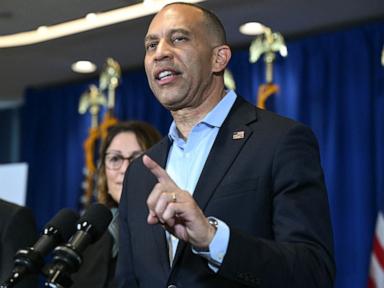
In a decisive statement that underscores the intensifying political confrontation in Washington, Hakeem Jeffries has declared his unequivocal support for the impeachment of Defense Secretary Pete Hegseth. Jeffries, who is poised to take the gavel as the next Speaker of the House following the Democrats' substantial gains in the recent midterm elections, made the announcement during an interview on ABC News' 'This Week.' His remarks serve as a clear signal that the incoming House leadership intends to wield its constitutional oversight powers aggressively, targeting one of the most prominent figures in the current administration's cabinet.
The political context for this declaration is rooted in the dramatic shift in congressional dynamics following Tuesday's electoral results. With Democrats securing a historic victory, the new majority is expected to prioritize accountability measures against the executive branch. Jeffries' endorsement of impeachment is not merely a rhetorical gesture but a strategic positioning that aligns with the party's platform of restoring institutional norms and challenging what critics describe as unauthorized expansion of presidential power within the Department of Defense. The move places immediate pressure on the White House and the Pentagon to defend the Secretary's conduct and decisions in the face of imminent congressional scrutiny.
During the broadcast, Jeffries emphasized the seriousness of the allegations and the necessity of upholding the rule of law, stating that the House must fulfill its duty to investigate and address potential abuses of power. His comments were met with immediate reaction from both parties, with Republican leaders warning of political weaponization of the impeachment process, while Democratic allies hailed the move as a necessary correction to executive overreach. This initial stakeholder response highlights the deep polarization that will define the early days of the new congressional session, setting the tone for a contentious legislative agenda focused on oversight and accountability.
In-Depth Analysis & Key Details
The decision to pursue impeachment against a sitting Secretary of Defense is a rare and historically significant move, reflecting deeper structural tensions between the legislative and executive branches. Historically, impeachment has been reserved for cases of clear constitutional violation or criminal conduct, but recent years have seen an expansion of its use as a political tool to challenge policy disagreements and administrative actions. The case against Hegseth likely involves allegations related to his management of the Department of Defense, potentially including issues of personnel decisions, budgetary oversight, or operational directives that critics argue bypassed established military protocols or congressional authority. This context is crucial for understanding the broader implications of Jeffries' announcement, which signals a willingness to test the limits of congressional power in the modern political landscape.
Competing perspectives on this issue reveal a fundamental divide over the interpretation of executive authority and legislative oversight. Supporters of the impeachment argue that the Department of Defense must remain insulated from partisan influence and that any deviation from established norms warrants immediate corrective action. Opponents, however, contend that impeachment is being used as a political weapon to undermine the administration's agenda and distract from other pressing national security challenges. This debate is further complicated by the technical intricacies of military law and the complex interplay between civilian control of the military and executive discretion in national defense matters. The economic consequences of prolonged impeachment proceedings could also be significant, as uncertainty in defense leadership may affect defense contractors and global security partnerships.
Expert analysis suggests that the outcome of this potential impeachment will have far-reaching implications for the balance of power in Washington. Legal scholars and political scientists are closely watching the House Judiciary Committee's response to Jeffries' declaration, as the committee's decision to refer the case to the full House will determine the next steps in the process. The case also raises important questions about the role of the media in shaping public opinion on complex political and legal issues, as broadcast interviews like the one on 'This Week' play a crucial role in informing citizens about the stakes involved. Ultimately, the Hegseth impeachment effort will serve as a litmus test for the new House leadership's commitment to institutional integrity and its ability to navigate the challenges of governing in a highly polarized environment.
"The pursuit of impeachment is not an act of political retribution, but a constitutional imperative to ensure that the most powerful security apparatus in the world remains accountable to the people it serves."
Why This Matters & What Lies Ahead
For everyday citizens, the potential impeachment of the Defense Secretary has direct implications for national security, military readiness, and the stability of the country's defense infrastructure. Uncertainty in the Department of Defense's leadership can affect the morale of troops, the efficiency of military operations, and the reliability of defense contracts that support thousands of jobs across the nation. Furthermore, the political conflict surrounding the impeachment could divert attention and resources from other critical issues, such as healthcare, education, and infrastructure, which are also vital to the well-being of the American public. The outcome of this process will also influence public trust in government institutions, as citizens watch to see whether the system can effectively hold its leaders accountable without descending into partisan gridlock.
Key upcoming milestones to monitor include the formal referral of the impeachment inquiry to the House Judiciary Committee, which is expected to occur in the coming weeks. The committee will need to determine the scope of the investigation and whether there is sufficient evidence to support the impeachment articles. Following this, the full House will vote on whether to impeach the Secretary, a process that requires a simple majority. If the House votes to impeach, the case will move to the Senate for a trial, where a two-thirds majority is required for conviction and removal from office. These procedural steps will be closely watched by legal experts, political analysts, and the public, as they will provide insight into the new House leadership's approach to oversight and accountability. Additionally, any related hearings or public statements from the Department of Defense or the White House will be critical in shaping the narrative and potentially influencing the outcome of the proceedings.
Source: Reported by ABC News · Analyzed & Synthesized by DNB Newsroom