State emergency managers confirmed that a controlled detonation of lead azide will occur Wednesday morning at the Middletown industrial site, a step taken to safely dispose of surplus explosive material stored for decades. The operation, overseen by the Iowa Department of Natural Resources in partnership with the U.S. Army Corps of Engineers, aims to neutralize the compound while minimizing environmental impact.
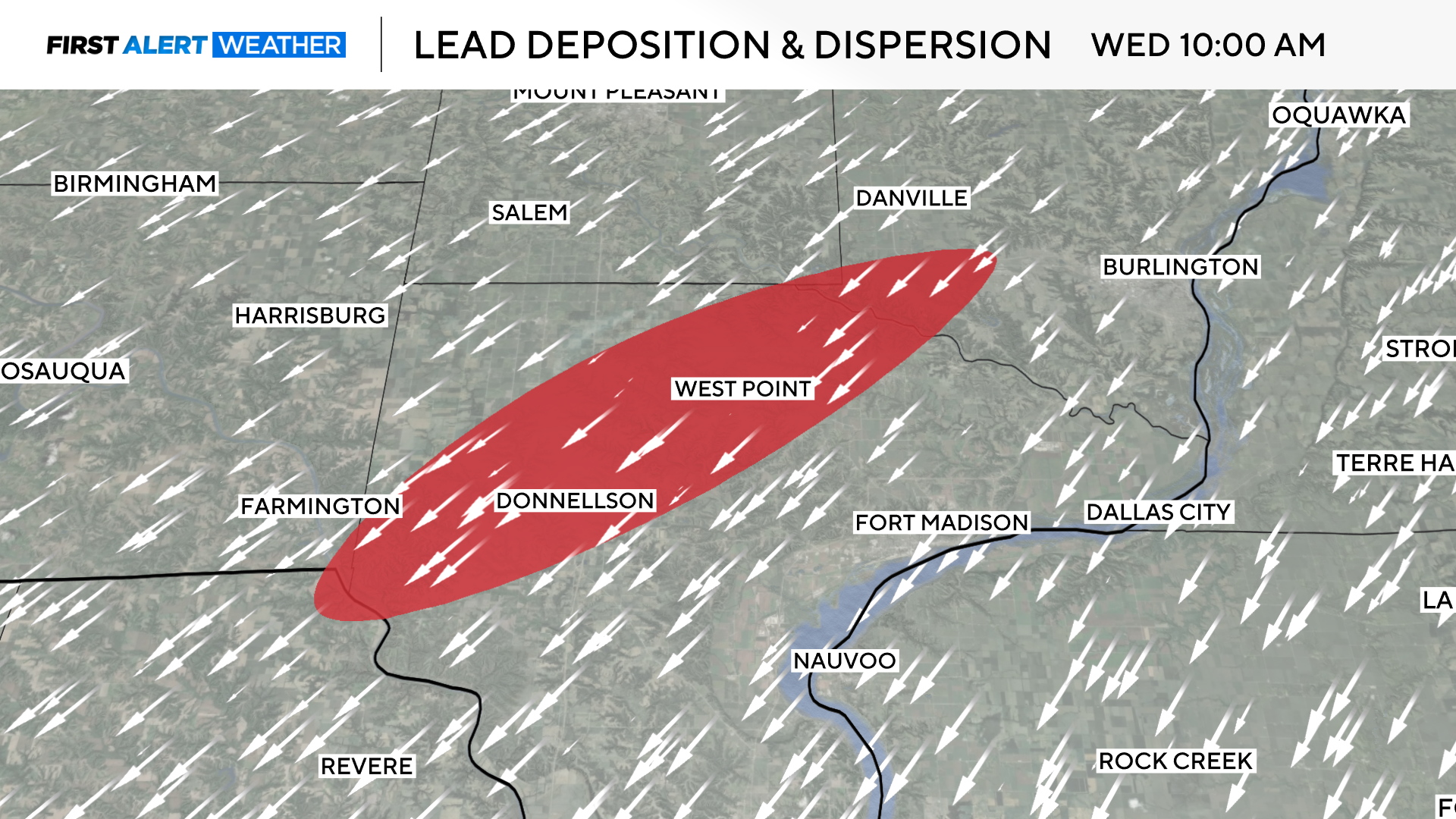
Meteorological projections released by the National Weather Service illustrate a shaded corridor of anticipated lead‑dust travel, stretching from the vicinity of Burlington eastward toward Macon, Missouri. The model predicts that prevailing westerly winds could carry fine particulate matter across the state line by noon, though officials caution that shifting weather patterns could expand or contract the affected zone.
Iowa Governor Kim Reynolds, speaking at a press briefing, emphasized that the detonation follows rigorous safety protocols and that real‑time monitoring will guide any additional protective actions. Local officials in both Iowa and Missouri have begun coordinating with school districts and agricultural groups to disseminate guidance on air‑quality precautions.
In-Depth Analysis & Key Details
The decision to detonate lead azide reflects a legacy of Cold‑War‑era munitions storage that has left many Midwestern sites with aging explosive inventories. Over the past two decades, federal and state agencies have grappled with the cost‑effective disposal of such materials, balancing public safety against the environmental hazards of uncontrolled releases.
Regulatory frameworks, including the Toxic Substances Control Act and the Clean Air Act, dictate stringent reporting and mitigation requirements for lead‑based explosives. However, divergent interpretations among state environmental departments and industry stakeholders have sparked debate over the adequacy of current plume‑modeling techniques and the threshold levels that trigger public health alerts.
Industry analysts note that the Middletown operation could set a precedent for how other jurisdictions handle similar legacy munitions, especially as climate‑driven weather volatility introduces new variables into dispersion modeling. The outcome may influence future funding allocations for advanced containment technologies and shape legislative proposals aimed at tightening hazardous‑material disposal standards.
"The Middletown blast underscores a pivotal moment where legacy munitions safety meets modern environmental accountability."
Why This Matters & What Lies Ahead
For residents living along the projected dust path, the immediate concern centers on inhalation exposure to lead particles, which can affect neurological development in children and exacerbate cardiovascular issues in adults. Local health departments are preparing to increase testing of air filters in schools and public buildings, while agricultural producers worry about potential soil deposition that could impact crop safety and marketability.
The next critical milestones include a mid‑week review by the Environmental Protection Agency to assess real‑time air‑quality data, followed by a congressional hearing slated for early next month on updating federal guidelines for explosive material disposal. Stakeholders will watch for any regulatory adjustments that could tighten emission thresholds, affect permitting processes, and allocate federal funds for remediation efforts in affected communities.
Source: Reported by CBS News · Analyzed & Synthesized by DNB Newsroom