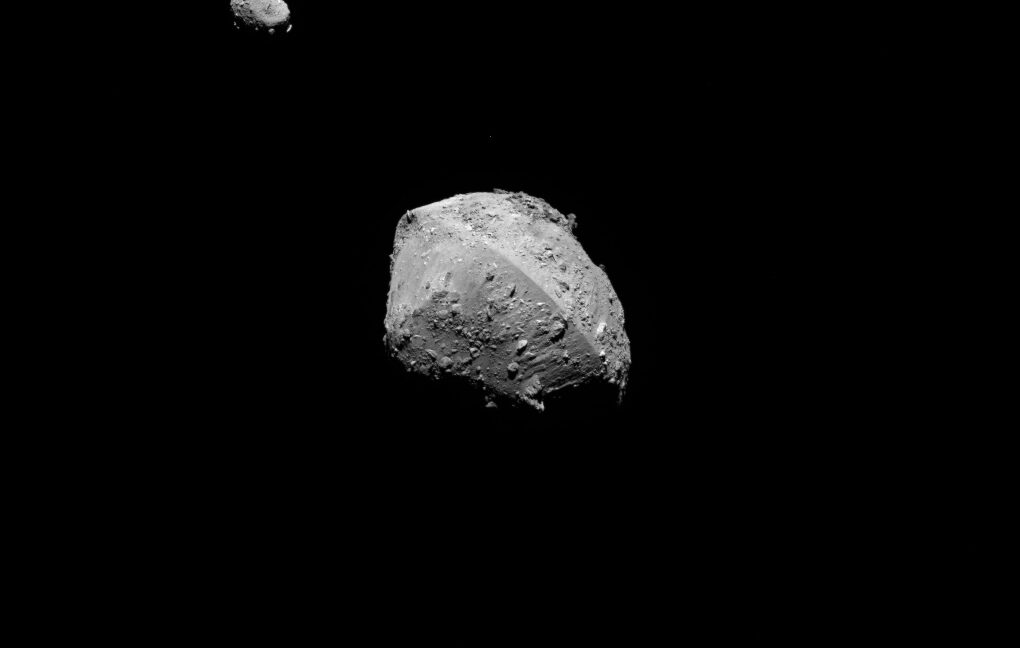
The European Space Agency’s Hera probe has successfully navigated to the Didymos asteroid system, positioning itself to scrutinize the aftermath of the historic DART mission. This arrival concludes a complex orbital insertion phase and initiates a multi-year campaign to gather high-resolution data on Dimorphos, the smaller moonlet of the binary system. The primary objective is to quantify the physical changes induced by the 2022 kinetic impact, transforming theoretical predictions into empirical measurements.
The operational context of Hera’s mission is defined by the unique binary nature of the target. Didymos, the larger primary asteroid, orbits in a stable path, while Dimorphos, its smaller companion, was the specific target of NASA’s DART spacecraft. By focusing on Dimorphos, Hera aims to characterize the crater size, the distribution of ejecta, and the alteration of the moonlet’s shape. This detailed topographic mapping is crucial for understanding how energy from an impact propagates through a non-rigid, rubble-pile body.
Officials from the European Space Agency have emphasized that the mission is not merely a scientific exercise but a foundational step for global planetary defense infrastructure. The data collected will serve as the baseline for assessing the effectiveness of kinetic impactors as a primary defense strategy. As Hera begins its initial survey operations, the scientific community anticipates a significant release of data that will refine the mathematical models used to predict the outcomes of future asteroid deflection attempts.
In-Depth Analysis & Key Details
The Hera mission represents a pivotal evolution in the field of planetary defense, shifting from theoretical simulations to direct empirical validation. Previous models of asteroid deflection relied heavily on assumptions about the internal density and cohesion of near-Earth objects. The DART mission, while successful in altering Dimorphos’s orbit, left critical questions unanswered regarding the efficiency of momentum transfer. Hera’s detailed analysis of the impact site will resolve these uncertainties, providing a concrete measure of the 'beta factor,' which describes the ratio of the ejecta momentum to the impactor’s momentum.
From a geopolitical and institutional perspective, the collaboration between NASA and the European Space Agency underscores a growing consensus on the necessity of shared planetary defense resources. The success of this joint effort strengthens the argument for international cooperation in monitoring and mitigating asteroid threats. Furthermore, the technical challenges of navigating and operating in the low-gravity environment of a small binary system set a precedent for future deep-space missions, highlighting the need for advanced autonomous navigation systems capable of functioning with minimal communication latency.
Industry analysts and aerospace engineers note that the insights gained from Hera will have direct implications for the design of future interceptors. Understanding how porous asteroids respond to impact allows for more accurate calculations of the required mass and velocity for a deflection mission. This knowledge is particularly vital given the increasing number of near-Earth objects identified by ground-based surveys. The mission also serves as a testbed for new technologies, including advanced propulsion systems and communication protocols, which are essential for the rapid response capabilities needed in a real-world planetary defense scenario.
"Hera’s arrival transforms the DART experiment from a successful demonstration into a precise scientific benchmark, providing the empirical foundation necessary to engineer reliable planetary defense systems."
Why This Matters & What Lies Ahead
For the general public, the success of the Hera mission reinforces the tangible progress being made in safeguarding Earth against existential threats. While the probability of a catastrophic asteroid impact in the near future remains low, the capability to detect and deflect such objects is a critical component of long-term planetary security. The data provided by Hera will enhance the accuracy of risk assessments, allowing policymakers and space agencies to prioritize resources for the most significant threats. This mission also inspires public interest in space exploration and planetary science, highlighting the collaborative nature of modern scientific endeavors.
Key upcoming milestones include the release of the first high-resolution images of the DART impact crater, which are expected to provide immediate insights into the structure of Dimorphos. Subsequent data analysis will focus on the long-term orbital dynamics of the binary system, monitoring any residual changes in Dimorphos’s trajectory. Regulatory bodies and space agencies will use these findings to update their planetary defense protocols and guidelines for future missions. The next major review of global asteroid monitoring capabilities is anticipated to incorporate the empirical data from Hera, ensuring that international defense strategies remain aligned with the latest scientific understanding.
Source: Reported by Ars Technica · Analyzed & Synthesized by DNB Newsroom