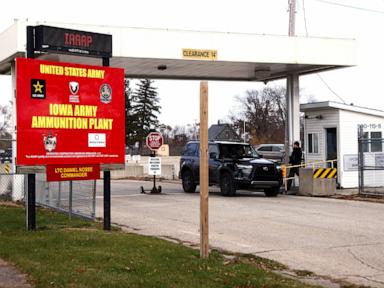
Federal and state officials gathered at the Des Moines Air National Guard Base on Tuesday to outline a joint mitigation strategy for the imminent controlled detonation of a legacy lead azide cache. The cache, estimated at nearly five tons, was discovered during a routine inventory at the former Iowa Army Ammunition Plant, prompting a multi‑agency response to address the hazardous material safely. The Department of Defense, in coordination with the Federal Emergency Management Agency and the Iowa Department of Natural Resources, will oversee the operation, which is scheduled for 0900 hours local time on June 30.
The blast site lies within a 2,500‑acre training complex located about 30 miles southeast of Des Moines, an area surrounded by agricultural land and a small residential community of roughly 2,000 people. Prior to the explosion, authorities will establish a three‑mile exclusion perimeter, deploy mobile air quality units, and conduct pre‑detonation soil and water sampling to establish baseline contamination levels. Emergency medical services and fire crews will be on standby, and a public notification system will broadcast real‑time updates to nearby residents via text alerts and local radio.
In a briefing, a senior Army spokesperson emphasized that the controlled explosion is the safest method to render the unstable compound inert, noting that alternative disposal techniques carry higher risk of accidental detonation. Environmental regulators highlighted that the mitigation plan includes post‑blast monitoring to ensure no residual lead or nitrogen compounds exceed state safety thresholds. Local officials praised the transparent coordination, while community leaders urged continued vigilance and swift remediation of any detected fallout.
In-Depth Analysis & Key Details
Lead azide, a primary explosive historically used in detonators, poses a significant stability challenge because it can decompose into highly sensitive compounds when exposed to heat, friction, or moisture. The U.S. military amassed large quantities of the material during the Cold War, and many stockpiles have since become obsolete, prompting a nationwide effort to safely eliminate them. Past incidents, such as the 2015 accidental detonation at a Texas depot, have underscored the necessity for controlled disposal methods that balance effectiveness with community safety.
Regulatory frameworks governing hazardous explosive disposal have evolved over the past two decades, with the EPA’s Toxic Substances Control Act and the Department of Defense’s Explosives Safety Board issuing joint guidelines for risk assessment and environmental protection. However, debates persist over the cost‑effectiveness of controlled detonations versus chemical neutralization, especially in regions where groundwater contamination risks are high. Industry analysts observe that the Army’s decision to proceed with a blast reflects a calculated trade‑off, leveraging the remote location and existing safety infrastructure to mitigate potential liabilities.
Safety advocates note that the comprehensive monitoring plan—featuring real‑time air quality sensors, post‑blast soil analysis, and independent third‑party verification—sets a new benchmark for transparency in military munitions disposal. While the operation is confined to a single site, its outcomes could inform future policy revisions, potentially prompting Congress to allocate additional funding for modernizing disposal technologies and expanding the EPA’s oversight authority over legacy military sites.
"A controlled detonation, when executed with rigorous monitoring and inter‑agency coordination, offers the most reliable path to neutralize aging lead azide while safeguarding nearby communities."
Why This Matters & What Lies Ahead
For residents within the blast radius, the immediate concern centers on exposure to airborne lead particles and nitrogen oxides that could arise from the explosion. Continuous air monitoring and prompt public advisories aim to prevent health incidents, especially among vulnerable groups such as children and the elderly. Moreover, the successful execution of the mitigation plan could reassure agricultural producers that soil and water quality will remain within safe limits, preserving the region’s key economic driver.
The broader implications extend to national security and environmental policy. As the Department of Defense evaluates the remaining inventory of legacy explosives, this operation may shape future legislative hearings on funding for safer disposal methods and stricter reporting requirements. Stakeholders will watch for post‑detonation data releases, which could trigger amendments to the EPA’s hazardous waste regulations and influence upcoming budget allocations in the FY 2027 defense appropriations bill.
Source: Reported by ABC News · Analyzed & Synthesized by DNB Newsroom