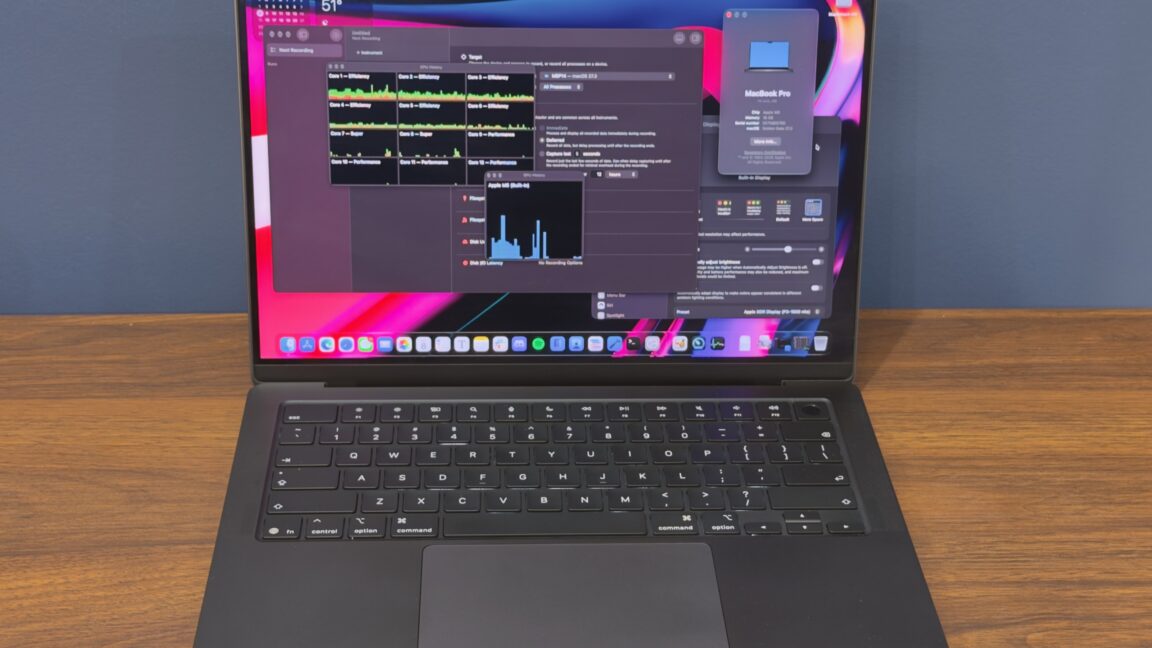
Apple has officially unveiled the latest iteration of its MacBook Pro lineup, headlined by the integration of the M6 processor. This update marks the third consecutive year of annual silicon refreshes for the company's professional laptop line, signaling a mature phase in Apple Silicon's development cycle. The M6 chip, built on a refined 3-nanometer process, is designed to handle intensive professional tasks with reduced thermal output, a critical factor for thin-and-light laptop designs.
The hardware configuration of the M6 MacBook Pro remains consistent with the previous generation's chassis, retaining the 14-inch Liquid Retina XDR display with a 120Hz ProMotion refresh rate. Unlike the higher-tier Pro and Max models, this variant does not include the additional HDMI and SD card slots, limiting its utility for journalists and photographers who require direct media capture without dongles. The device is available in Space Black and Silver finishes, with base storage configurations starting at 512GB to align with the increasing data demands of modern creative workflows.
In its official press materials, Apple emphasized the M6's neural engine capabilities, which now support on-device large language model inference at speeds 30% faster than the M5. The company stated that this update is intended to provide a seamless transition for users upgrading from Intel-based MacBooks, highlighting the significant leap in performance-per-watt. Initial reactions from tech analysts suggest that while the performance gains are notable, the lack of new form-factor innovations means the device serves primarily as a spec bump rather than a generational leap.
In-Depth Analysis & Key Details
The release of the M6 MacBook Pro must be viewed within the context of Apple's shift from a feature-driven to a performance-driven release cadence. Historically, Apple used major hardware redesigns to mark significant generational changes in its Mac lineup. However, the standardization of the MacBook Pro chassis in recent years has allowed the company to decouple software and silicon updates from physical design changes. This strategy reduces manufacturing complexity and allows for more frequent, predictable updates, aligning with the subscription-based software models that dominate the professional creative sector.
From a competitive standpoint, the M6 MacBook Pro faces increasing pressure from high-performance Windows laptops equipped with NVIDIA's latest discrete GPUs. While the M6 offers superior battery life and unified memory architecture, which is advantageous for machine learning tasks, it lacks the raw rasterization power of dedicated graphics cards. This creates a distinct market segmentation where Apple targets users who prioritize portability and ecosystem integration, while competitors target users who require maximum graphical fidelity for gaming or high-end 3D rendering. The absence of new ports in the base model further underscores this segmentation, forcing users who need direct display outputs to purchase the higher-priced Pro or Max variants.
Industry analysts observe that the M6's focus on neural engine acceleration reflects a broader industry trend toward on-device AI processing. As cloud-based AI services become more expensive and latency-prone, the ability to run sophisticated language and image models locally is becoming a key differentiator for professional hardware. The M6's architecture is specifically optimized for this workload, suggesting that Apple is positioning its hardware not just as a computing tool, but as a local AI inference engine. This shift has significant implications for software developers, who are increasingly building applications that leverage on-device AI capabilities to provide real-time, private, and offline-responsive features.
"The M6 MacBook Pro represents a strategic consolidation rather than a revolution, prioritizing the efficiency of existing infrastructure over the novelty of new hardware forms."
Why This Matters & What Lies Ahead
For everyday consumers and professional users, the M6 MacBook Pro offers a compelling balance of performance and price, particularly for those who do not require the highest-end display features. The improved battery life and thermal management mean that users can work longer without charging and experience less fan noise during intensive tasks. This makes the device a more viable option for mobile professionals who are frequently on the go. However, the lack of new ports and the retention of the 60Hz base display in some configurations may be a limiting factor for users who rely on direct media capture or high-refresh-rate visual editing.
Looking ahead, the release of the M6 MacBook Pro sets the stage for potential software updates that will further leverage the new neural engine capabilities. Users should monitor upcoming macOS releases for new AI-powered features that may require the M6 or later hardware. Additionally, the competitive landscape will likely see responses from other manufacturers, who may accelerate their own silicon development to match Apple's performance-per-watt metrics. For investors, this release reinforces Apple's strong position in the premium laptop market, although the incremental nature of the update may limit short-term sales spikes compared to previous generational leaps.
Source: Reported by Ars Technica · Analyzed & Synthesized by DNB Newsroom