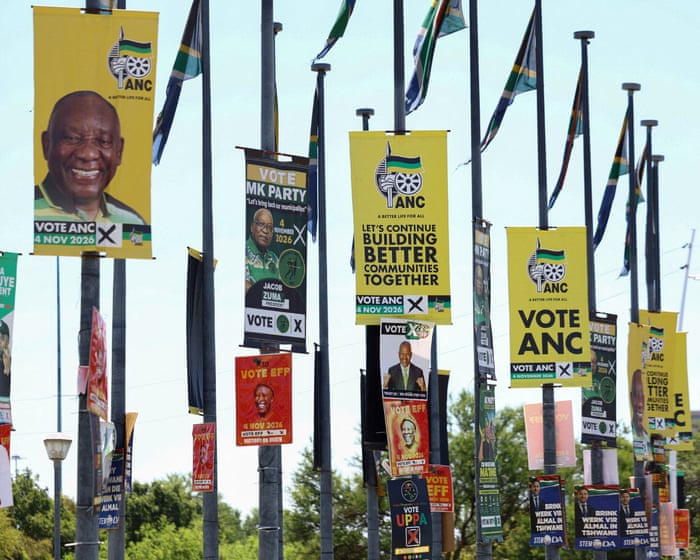
In a decisive blow to South Africa’s ruling party, the African National Congress (ANC) is on track to record its worst local government election result since the dawn of democracy. With 80% of ballots counted, the party’s national vote share has fallen to under a third of the total, a stark contrast to the near-monopoly it held for decades. This collapse is not merely a statistical anomaly but a visceral rejection by voters who have endured years of water shortages, electricity blackouts, and rising unemployment. The ANC, which led the country out of apartheid under Nelson Mandela, now finds itself struggling to maintain even a simple majority in key metropolitan areas, including parts of Gauteng, the economic heart of the nation.
The geographic distribution of the loss reveals a deepening urban-rural divide and a specific vulnerability in the party’s traditional strongholds. While the ANC retains significant support in rural provinces like Limpopo and Mpumalanga, it has been decisively outmaneuvered in urban centers where the impact of poor service delivery is most acute. The Democratic Alliance (DA) has consolidated its grip on the Western Cape and is making inroads in the Northern Cape, while the MK Party, founded by former general secretary S’bu Ndebele, has emerged as a formidable third force, siphoning off disaffected ANC members and voters frustrated by the party’s internal discipline and corruption scandals.
Reaction from within the ANC has been one of guarded concern, with senior party officials refusing to concede defeat until the final counts are certified by the Electoral Commission of South Africa (IEC). However, the tone of official statements has shifted from confidence to caution, acknowledging the 'harsh reality' of voter sentiment. Opposition leaders, meanwhile, are framing the result as a mandate for change, urging the national government to prioritize economic reform and service delivery over ideological maneuvering. The immediate implication is a more complex patchwork of municipal governments, where no single party can claim uncontested authority across the country’s 257 local municipalities.
In-Depth Analysis & Key Details
This electoral defeat is the culmination of structural decay that has plagued the ANC for over a decade. Historically, the party’s dominance was underpinned by a social contract: political representation in exchange for basic service delivery and economic inclusion. That contract has effectively broken down. The 'Load Shedding' crisis, where rolling blackouts became a daily reality, and the collapse of water infrastructure in cities like Cape Town and Johannesburg, have eroded the trust that sustained the ANC’s post-1994 hegemony. The party’s failure to modernize its organizational structure and address systemic corruption has left it vulnerable to more agile opposition movements that promise accountability and efficiency.
The rise of the MK Party and the consolidation of the DA highlight a fragmented opposition that is successfully capitalizing on ANC weaknesses. While the DA focuses on economic liberalism and urban governance, the MK Party appeals to the ANC’s base by criticizing the party’s leadership from within, arguing that the current elite has betrayed the liberation movement’s principles. This internal schism is particularly damaging because it suggests that the issue is not just policy disagreement but a crisis of legitimacy. Economists note that this political instability creates uncertainty for foreign investment, as investors seek stable governance structures to protect long-term capital projects in infrastructure and manufacturing.
From a technical governance perspective, the shift toward multi-party municipal coalitions will require new mechanisms for policy coordination. In the past, the ANC’s dominant position allowed for streamlined, albeit often top-down, implementation of national directives. Now, local governments controlled by different parties may prioritize different agendas, potentially leading to policy inconsistencies across provincial boundaries. This fragmentation could complicate national efforts to address cross-cutting issues such as energy security, water management, and urban planning, requiring more robust intergovernmental cooperation and negotiation skills from all levels of government.
"The ANC’s electoral collapse is not just a loss of seats; it is the dissolution of the post-apartheid social contract, forcing South Africa to navigate a new era of political pluralism and contested governance."
Why This Matters & What Lies Ahead
For everyday South Africans, this result signals a potential turning point in the quality of public services. With the DA and other opposition parties gaining control of more municipalities, voters in those areas may see improvements in water, electricity, and sanitation, while ANC-held areas may face continued pressure to reform or risk further vote loss in the next cycle. For the global economy, South Africa’s political stability is a key indicator for broader African market confidence. A fragmented political landscape could slow down large-scale infrastructure projects, affecting supply chains for mining, agriculture, and manufacturing. The financial markets have already reacted to the news, with the Rand experiencing volatility as investors reassess the risk profile of South African assets.
In the coming weeks, the focus will shift to the formal certification of results by the IEC and the subsequent formation of municipal executive committees. Key milestones to monitor include the appointment of mayors in major metros like Johannesburg, Cape Town, and Durban, as well as any legal challenges from losing parties. The national government will also face intense scrutiny over its response to the election results, with opposition parties likely to demand immediate policy concessions or coalition talks. The next six months will be critical in determining whether this electoral shift leads to constructive political competition or further institutional instability.
Source: Reported by The Guardian · Analyzed & Synthesized by DNB Newsroom


