dailynewsnblog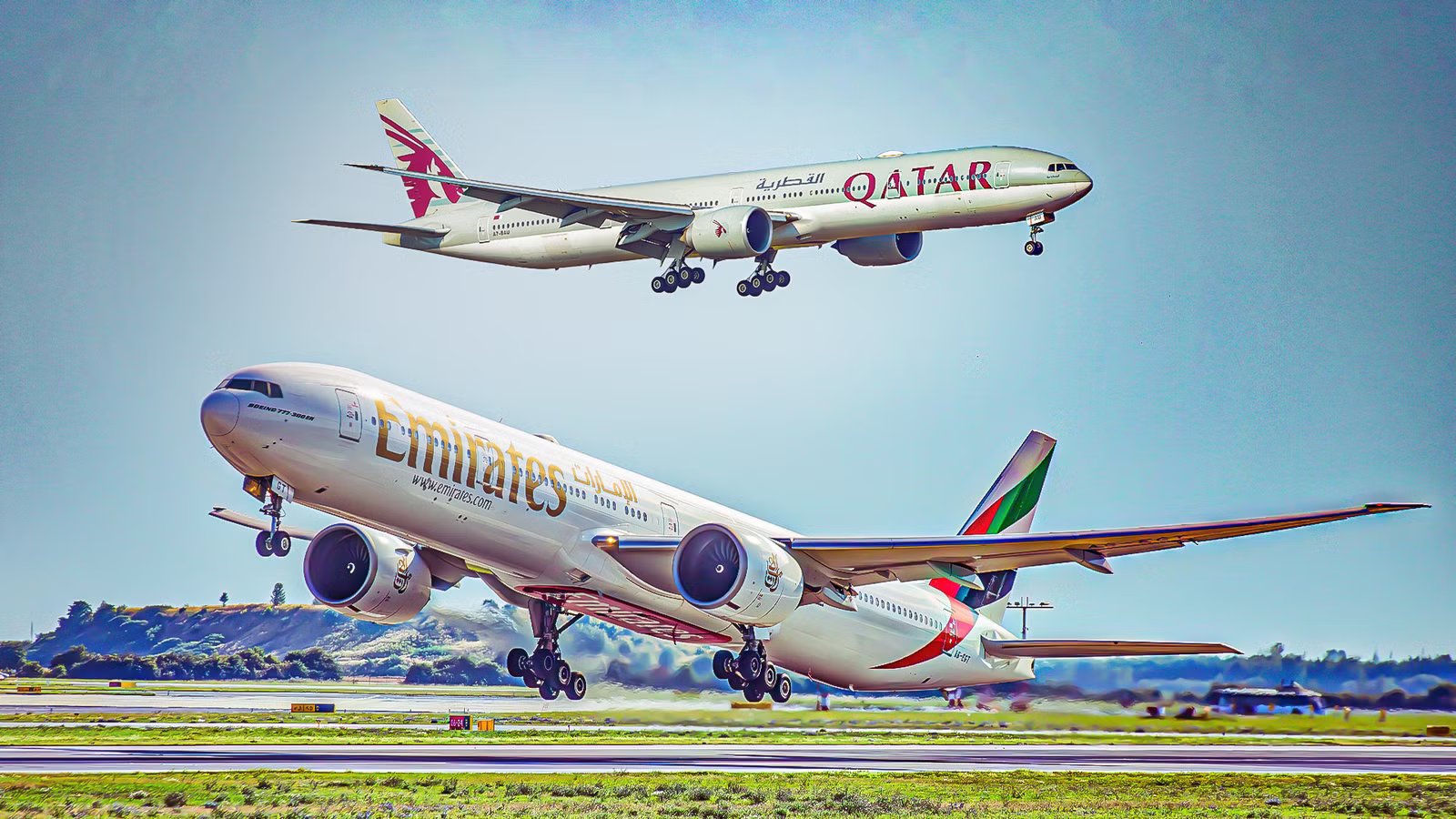
When a widebody leaves Dubai or Doha in  Emirates or
  Qatar Airways livery, it’s likely a Boeing 777. For more than two decades, the “Triple Seven” has anchored both carriers’ hub-and-spoke networks, linking Europe, Asia, Africa, and the Americas through the Gulf.
For aviation fans, that naturally raises a question: which of the two Gulf giants has more 777s, and how differently do they use them? This guide compares their fleets, looks at what passengers experience on board, and explores how Emirates and Qatar use Boeing’s long-haul workhorse before asking who really “wins” the 777 battle.
How The 777 Became The Gulf’s Long-Haul Workhorse

Before the double-deck A380 grabbed all the headlines, the Boeing 777 quietly built the Gulf super-connectors. Launched in the mid-1990s, the 777 was Boeing’s answer to a new generation of long-haul flying: big enough to replace older four-engine widebodies, but efficient enough to fly twin-engine routes under extended-range ETOPS rules. Early -200 and -200ER variants paved the way, but the ultra-long-range 777-200LR and high-capacity 777-300ER turned the aircraft into a true global workhorse.
For Middle Eastern carriers, the timing was perfect. Emirates and Qatar Airways both sit within a single long-haul hop of most of the world’s population. The 777’s combination of range, belly cargo space, and reliability enabled them to build dense banks of connections through Dubai and Doha, offering one-stop links between city pairs that previously required two or three stops.
As their networks grew, so did their appetite for the 777. The type could handle overnight runs to Europe and Asia, daylight flights to Africa, and ultra-long-haul missions to the Americas and Oceania. In many ways, the 777 became the machine that turned the Gulf carriers from regional airlines into global brands.
Inside Emirates’ 777 Empire

If this were a pure numbers contest, Emirates would win by a wide margin. According to its 2025 fleet disclosure, Emirates operates 140 Boeing 777s. That includes 11 777-200F freighters, 10 777-200LRs, and 119 777-300ERs. The mix is heavily weighted toward the 777-300ER, which acts as the airline’s primary long-haul passenger workhorse alongside a shrinking but still significant A380 fleet.

Emirates Orders 65 Boeing 777-9s & Pushes For 777-10 Feasibility Study
130 GE9X engines will power Emirates’ new jets.
The 777-300ERs serve high-demand routes linking Dubai with major cities across Europe, Asia, Africa, and the Americas. Their blend of range and capacity makes them ideal for slot-constrained airports and for feeding Emirates’ tightly timed connection banks. The smaller 777-200LRs are reserved for missions where range matters more than seats, such as ultra-long-haul sectors and certain thinner long-distance routes.
Emirates SkyCargo adds another dimension. With 11 777-200Fs plus belly space in the passenger fleet, the airline uses the type to move high-value freight such as pharmaceuticals, perishables, and e-commerce through Dubai’s cargo hub, including markets that may not support a large passenger schedule but still generate strong cargo demand.
For passengers, Emirates’ 777s can feel like different aircraft depending on the layout. Many 777-300ERs feature a dense ten-abreast economy cabin in a 3-4-3 layout, which maximizes seats but can feel tight on long sectors. At the same time, the airline has invested in refreshed business-class products and premium economy on selected frames, gradually upgrading its hard product as it prepares for the next-generation 777X.
|
Aircraft Variant |
Active |
Inactive |
Total |
|---|---|---|---|
|
B777-200F |
11 |
11 |
|
|
B777-200LR |
8 |
2 |
10 |
|
B777-300ER |
116 |
3 |
119 |
Qatar Airways’ Focused 777 Fleet

Qatar Airways flies fewer 777s than Emirates, but it squeezes a lot of performance and revenue out of each one. According to its latest fleet figures, Qatar operates 92 Boeing 777s. The split is 28 777-200F freighters, 7 777-200LRs, and 57 777-300ERs. That makes the 777 family one of the main pillars of the airline’s widebody fleet alongside a large group of Airbus A350-900s and A350-1000s.
The 777-300ER handles many of Qatar’s longest and busiest passenger routes from Doha, particularly to Europe, Asia, and North America. Its range allows the airline to connect Doha to major cities in a single hop while offering a full range of cabin products. The smaller but ultra-long-range 777-200LR occupies a niche on routes that demand extra performance, including long, thin city pairs where capacity needs to stay modest but range and payload cannot be compromised.
Where Qatar really stands out is cargo. With 28 dedicated 777-200Fs, the airline has one of the world’s largest twin-engine freighter fleets. These aircraft operate under the Qatar Airways Cargo brand, feeding a Doha-centric network that has grown rapidly in parallel with the passenger operation. The 777-200F offers payload–range performance similar to the now-retired 747-400F, but with twin-engine economics that better aligns with modern fuel and maintenance costs.
For passengers, Qatar’s 777 experience is closely tied to the airline’s premium strategy. Many 777-300ERs feature the well-regarded Qsuite business-class product, with enclosed suites and flexible seating arrangements. Economy layouts vary between denser ten-abreast and more spacious nine-abreast configurations depending on route and frame, but overall, the airline positions the 777 as a flagship alongside the A350 rather than a step below it.
|
Aircraft Variant |
Active |
Inactive |
Total |
|---|---|---|---|
|
B777-200F |
28 |
28 |
|
|
B777-200LR |
5 |
2 |
7 |
|
B777-300ER |
55 |
2 |
57 |
Same Airframe, Different Passenger Experience

To travelers, seeing “Boeing 777” on a booking screen does not guarantee the same experience on Emirates and Qatar Airways. Both carriers rely heavily on the 777-300ER, but the way they fit out the cabin differs. Emirates typically opts for a dense economy layout with ten-abreast seating in a 3-4-3 configuration. That helps keep costs per seat low and supports high-demand routes, but it can leave window and middle seat passengers with slightly less width and shoulder room on longer flights.
Qatar Airways, by contrast, has used a mix of nine-abreast and ten-abreast layouts depending on the aircraft and market. Where nine-abreast seating is offered, economy passengers gain a little more personal space at the expense of overall capacity. Even on its denser aircraft, Qatar leans on service standards and inflight amenities to keep the experience competitive.
The gap is even clearer in business class. Emirates’ 777 fleet still features a blend of older angled-flat seats and newer fully flat products, so the experience can vary by route and airframe. Many of Qatar’s 777-300ERs, meanwhile, are fitted with Qsuite, offering enclosed suites, flexible seating for couples or groups, and a level of privacy that has earned a strong reputation among frequent flyers.

Emirates’ 7 Boeing 777 Layouts: What’s Inside?
The carrier’s different configurations for the 777 allow it to serve a wide range of passenger markets with the type.
Noise and ride quality are broadly similar thanks to the 777’s robust design and powerful engines, but details such as mood lighting, in-flight entertainment interfaces, and WiFi performance vary by airline and refit cycle. For passengers choosing between Emirates and Qatar on the same city pair, the letters “77W” on a flight display tell only part of the story. The brand and specific cabin product still matter a great deal.
How Each Airline Uses The 777’s Strengths

Behind the scenes, fleet planners at Emirates and Qatar think about the 777 in slightly different ways. For Emirates, the 777-300ER is the backbone of a high-capacity hub-and-spoke model. The airline uses the type to concentrate large flows of passengers into Dubai, timing arrivals and departures in waves that connect Europe, Asia, Africa, and the Americas. High seat counts and strong belly cargo capability allow Emirates to keep unit costs low in sectors where demand is consistently strong. The 777-200LR and 777-200F variants then fill specific roles at the edges of that model: ultra-long-haul routes and cargo-focused markets.
Qatar Airways leans more heavily on a mixed widebody fleet. The 777 shares long-haul duties with the A350, with the A350 taking some thinner or more range-sensitive missions and the 777-300ER focusing on high-demand city pairs. The large 777-200F fleet lets Qatar operate a cargo network that does not always mirror its passenger schedule, giving the airline flexibility to chase freight demand even when passenger traffic is weaker.
Both carriers use the 777’s strong payload capability to their advantage. The aircraft can carry substantial cargo even on long sectors, making it attractive for routes with high freight yields. At the same time, fuel efficiency and commonality across variants help keep operating costs in check, especially compared with older four-engine aircraft that the 777 has gradually replaced.
In operational terms, reliability also matters. A twin-engine long-haul aircraft with high dispatch reliability enables airlines to schedule tight turnarounds and maintain complex global networks with fewer disruptions. For carriers that promise near-seamless connections through their hubs, that reliability is almost as important as range or seat count.
So, Who Really Wins The 777 Battle?

If you judge purely by numbers, Emirates clearly wins the 777 contest. With 140 aircraft against Qatar Airways’ 92, it operates the world’s largest 777 fleet and relies on the type more heavily than any other airline. In slot-constrained airports and high-demand markets, that scale gives Emirates a powerful advantage in terms of capacity and network reach.
Qatar Airways, however, makes a strong case on other metrics. A higher share of dedicated 777 freighters, widespread use of Qsuite on 777-300ERs, and a complementary partnership with the A350 fleet mean each aircraft is deployed very specifically. For passengers, Qatar’s consistency in business class product and service can make its 777s feel more premium, even if there are fewer of them.
From Boeing’s perspective, both airlines are star customers. The 777 has enabled Emirates and Qatar to build global reputations and dense networks from relatively small home markets, while the airlines, in turn, have showcased what the aircraft can do over long distances with high utilization. Both carriers are now preparing to move into the next chapter with the 777X, which will eventually inherit much of the long-haul work currently done by today’s 777-300ERs.
In the end, the “winner” depends on what you value most. Emirates comes out ahead on sheer numbers and capacity, using the 777 as the backbone of a very large long-haul operation. Qatar Airways makes its case through a more consistent premium product, a particularly strong 777 freighter fleet, and the way it blends the type into a mixed widebody lineup alongside the A350.
For most travelers and aviation enthusiasts, the real takeaway is that both carriers have pushed the 777 hard. The aircraft has become a core tool for connecting its hubs to the rest of the world and remains at the center of one of the most competitive long-haul markets anywhere.