

 dailynewsnblog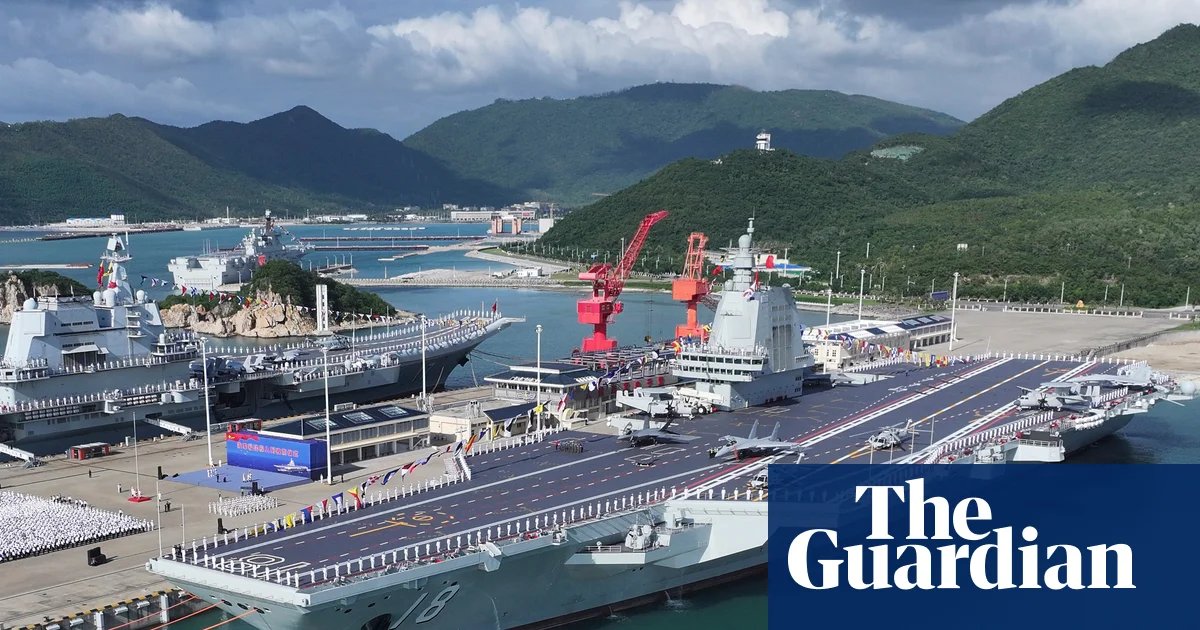
In port, the 80,000-tonne Fujian aircraft carrier would be impossible to miss. More than 300 metres long and capable of carrying about 60 aircraft, the £5.4bn super-vessel places China second among the world’s navies, with three aircraft carriers, though still a long way behind the global leader, the US, which has 11.
Yet for all the great power projection of the new warship, nearly 5,000 miles away from its home port another conflict appears to suggest size may not matter. In the Black Sea, Ukraine achieved an extraordinary military success by inflicting a “functional defeat” on Russia’s naval fleet using swarms of skilfully targeted sea drones.
The contradiction, however, is likely to be more apparent than real. In a new era of state competition, and in particular the growing rivalry between China and the US, for all their size and expense, aircraft carriers remain an attractive resource for projecting power and conducting harder edged diplomacy.
This is why the US president, Donald Trump, ordered the USS Gerald R Ford – at $12.8bn the world’s largest and most expensive warship – to sail to Venezuela to intimidate the country’s regime. Capable of carrying 70 aircraft, able to operate up to 125 sorties at peak, and with four destroyers in support, the manoeuvre was so unusual it raised the question of whether the force on display would be used against President Nicolas Maduro.
It is also the reason why there has been so much interest in the building and testing of the Fujan, whose formal launch earlier this week was attended by China’s president, Xi Jinping. It is a demonstration of Beijing’s fast-growing military power: its first aircraft carrier, the Liaoning, completed in 2012, was built from a hulk first made in the Soviet Union in the late 1980s and sold on by Ukraine after its collapse.
Ironically, as Nick Childs of the International Institute for Strategic Studies notes, China has also invested heavily in anti-ship missiles to try to protect its coast from the US. But, he says, Beijing clearly sees “aircraft carriers as an indispensable element in building a navy that can independently project power and influence globally”, because they remain “unrivalled in their flexibility” and are “incredibly useful in a whole range of potential conflict scenarios” – one of which may one day be an attempt to force a reunification with Taiwan.
The UK, which completed the build and deployment of two aircraft carriers for £6.2bn four years ago, has far less global power, making its military need less obvious. Neither ship was deployed during the Middle East conflict of the past two years, though their construction secured jobs in Scotland’s shipyards during the 2010s. Their use so far has been as a form of floating diplomacy, as demonstrated by the visit by HMS Prince of Wales to Tokyo in August to impress allies rather than to intimidate.
For now, aircraft carriers are not expected to meet a military threat with the tactical sophistication of Ukraine, never mind a peer-level opponent. Houthi rebels in Yemen attacked the USS Harry S Truman aircraft carrier and its support destroyers with drones in the Red Sea earlier this year. But the most serious damage doneduring the attack was not to the warship, but to a $70m F/A-18E Super Hornet fighterthat fell overboard when the carrier turned to avoid incoming fire.
Destroyers, such as the Royal Navy’s HMS Diamond, which specialise in shooting down incoming drones, form the heart of the carrier strike groups that protect the mother ship. In theory, even if struck, carriers are designed to be hard to sink. The Soviet rule of thumb in the cold war was that it would take 12 conventional missiles to bring down a super-carrier; while it took four weeks for the US to sink USS America in 2005, a test in which the American vessel was shot at in an effort to establish how resilient it was in practice.
As for the Black Sea, the Ukrainian success came against a small, poorly organised navy, far weaker certainly than the US or China. Russia does not possess a functioning aircraft carrier, and has not had one since 2017 when the 40-year-old Admiral Kuznetsov put in for repair. The country’s shipbuilding chief said it was likely to be scrapped or sold. The failure to modernise or replace it is a demonstration of wider Russian geopolitical, military and economic weaknesses.


