dailynewsnblog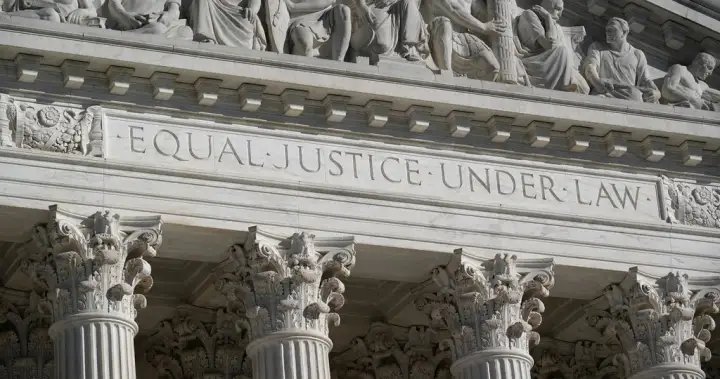
The U.S. Supreme Court agreed on Friday to decide the legality of President Donald Trump’s directive to restrict birthright citizenship in the United States, a contentious part of his efforts to curb immigration and a step that would alter how a 19th century constitutional provision has long been understood.

The justices took up a Justice Department appeal of a lower court’s ruling that blocked Trump’s executive order telling U.S. agencies not to recognize citizenship of children born in the U.S. if neither parent is an American citizen or legal permanent resident, also called a “green card” holder.
The lower court ruled that Trump’s policy violated the U.S. Constitution’s 14th Amendment and a federal law codifying birthright citizenship rights in a class-action lawsuit by parents and children whose citizenship is threatened by the directive.
The Republican president signed the order his first day back in office on January 20 as part of a suite of initiatives he has pursued during his second term as president to crack down on legal and illegal immigration.

The 14th Amendment has long been interpreted as guaranteeing citizenship for babies born in the United States.
The amendment’s Citizenship Clause states that all “persons born or naturalized in the United States, and subject to the jurisdiction thereof, are citizens of the United States and of the state wherein they reside.” The 14th Amendment was ratified in 1868 in the aftermath of the Civil War of 1861-1865 that ended slavery in the United States.

Get daily National news
Get the day’s top news, political, economic, and current affairs headlines, delivered to your inbox once a day.
The Trump administration has argued that the provision does not grant citizenship to the babies of immigrants who are in the country illegally or whose presence is lawful but temporary, such as university students or those on work visas.
It has asserted that the phrase “subject to the jurisdiction thereof” means that being born in the United States is not enough for citizenship. Citizenship is granted only to the children of those whose “primary allegiance” is to the United States, including citizens and permanent residents, it has argued. Such allegiance is established only through “lawful domicile,” which government attorneys define as “lawful, permanent residence within a nation, with intent to remain.”
Trump administration says policy leads to ‘birth tourism’
The administration has said that granting citizenship to virtually anyone born on U.S. soil has created incentives for illegal immigration and led to “birth tourism,” by which foreigners travel to the United States to give birth and secure citizenship for their children.
The legal challenges appealed by the Justice Department concerned one lawsuit filed by the states of Washington, Arizona, Illinois and Oregon, and another filed in federal court in New Hampshire by plaintiffs who sued on behalf of a nationwide class of people affected by Trump’s order.


In July, the San Francisco-based 9th U.S. Circuit Court of Appeals sided with the states. Also in July, Concord, New Hampshire-based U.S. District Judge Joseph Laplante let the plaintiffs in that case proceed as a class, allowing Trump’s order to be blocked nationally.
The challengers said the Supreme Court already settled the question of birthright citizenship in an 1898 case called United States v. Wong Kim Ark, which long has been interpreted as guaranteeing that children born in the U.S. to non-citizen parents are entitled to American citizenship under the 14th Amendment.
The challengers also point out that Trump’s order violates a law Congress passed in 1940 that was subsequently included in the Immigration and Nationality Act of 1952. That measure codified the Citizenship Clause’s language and also adopted what was by then the well-settled understanding that the 14th Amendment promised automatic birthright citizenship.

The birthright citizenship fight had landed at the Supreme Court already once this year. After lower courts halted Trump’s order, the administration took the matter to the Supreme Court to challenge the power of federal judges to issue so-called “universal” injunctions preventing presidential policies from applying against anyone, anywhere.
The Supreme Court, in a 6-3 ruling powered by its conservative majority, issued a ruling in June blunting the power of federal judges but did not resolve the legality of Trump’s directive. The ruling left open the possibility for courts to grant broad relief to states or to individual plaintiffs through class action lawsuits.
The Supreme Court has sided with Trump in a series of decisions this year allowing various policies to take effect after they were impeded by lower courts that cast doubt on their legality. Among these policies were Trump’s revocation of temporary legal protections on humanitarian grounds for hundreds of thousands of migrants, deportations of migrants to countries other than their own and domestic immigration enforcement raids.