dailynewsnblog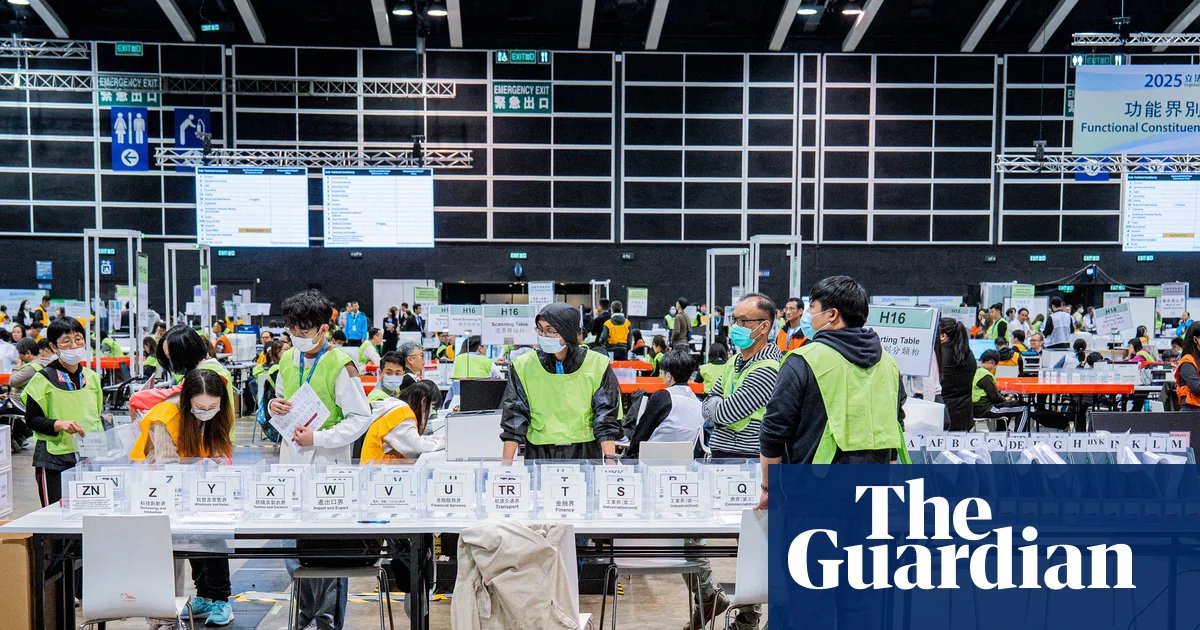
Hong Kong saw a near-record low turnout in Sunday’s “patriots only” Legislative Council elections, with fewer than 32% of voters turning out, as the number of registered voters fell for the fourth consecutive year.
At 31.9%, Sunday’s turnout is marginally higher than 2021’s record low of 30.2%. But fewer people overall voted this year: 1.3 million compared to 1.4 million in 2021. Hong Kong’s population is about 7.5 million.
Only candidates vetted as “patriots” by a government committee were allowed to stand for election in the city’s 90-seat legislature. Only 20 of those seats are directly elected.
The government mounted a huge campaign to encourage people to vote, extending the opening hours of polling stations by two hours compared with 2021 and plastering the city with posters urging people to turn out.
Voters also received a “thank you card” that could be redeemed in local businesses for rewards and authorities released an election anthem called “Let’s Vote, Together We Create the Future”, inspired by Cantopop star Aaron Kwok’s 2001 hit song Strong.
After an electoral overhaul in 2021, only pro-Beijing “patriots” have been allowed to run for government in Hong Kong, and the proportion of seats that are elected – rather than appointed – has been reduced. It means that boycotting the vote is one of the only ways that Hongkongers can safely express their dissatisfaction.
Inciting others to boycott the vote was criminalised in 2021. On Sunday, Hong Kong’s Independent Commission Against Corruption (Icac) said that four men, aged between 31 and 44, had been arrested for allegedly inciting others not to vote, or to cast invalid votes, in social media comments. The Icac said all up it had arrested 11 people for allegedly contravening laws in relation to the offence during the current election, and three had so far been prosecuted.
The election took place in the shadow of Hong Kong’s worst tragedy in decades, the Tai Po fire that killed at least 159 people in a blaze that spread across seven apartment blocks at a residential compound in northern Hong Kong.
As more revelations come to light about alleged building safety violations and questions over lax or negligent enforcement, residents in Hong Kong have demanded transparency from the government about the investigation, and any official culpability.
But mourning activities and calls for accountability over the fire have sparked suspicion among authorities in Hong Kong. Instead they have launched a sweeping crackdown in the biggest test of Beijing’s national security regime in the city since the pro-democracy protests in 2019 and 2020.
At least three people are thought to have been arrested for alleged national security offences: Miles Kwan, a Hong Kong student who started an online petition calling for government accountability, former district councillor Kenneth Cheung and Wong On-yin, a 71-year-old political commentator.
On Saturday the government cleared an impromptu memorial site near the burned buildings, where people had been laying flowers in tribute for days. The pre-announced clearing began late at night.
“I wish it could go for longer as I believe there are still people who did not have enough time or the chance to express their feelings,” one resident told Reuters.
Earlier that day, the chief superintendent of the police’s national security department, Steve Li, told media he had seen “familiar” scenes at Tai Po which reminded him of the 2019 protests, claiming the presence of pamphlets and signs “basically unrelated to the disaster”, reported the Hong Kong Free Press.
“I’ve been there to observe, and I think the situation was becoming more and more like that of ‘black-clad violence’,” Li said.
Authorities also targeted foreign press over their reporting of the fire, with representatives of outlets including the New York Times called in by authorities on Saturday.
Some Hongkongers who had been posting about the fires online, or contributing to civilian digital information resources, have stopped, citing “force majeure” or concerns about their activity being “misconstrued” by authorities. Last week at the Hong Kong Baptist University a student-made “democracy wall” calling for justice for victims was covered up, and the next day the student union was shut down.