dailynewsnblog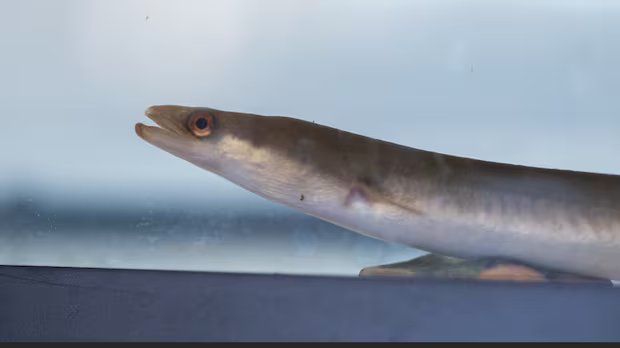
After Canada announced Tuesday it wouldn’t list the American eel under the Species at Risk Act (SARA) some First Nations people with cultural and spiritual ties to the species are questioning the decision.
“Right now it doesn’t seem hopeful because we don’t see anything being done to help them,” said Charles Doucette, fisheries director with Potlotek First Nation on Cape Breton Island.
Doucette has vivid memories of his dad coming home with a load of eels to hang in the basement to dry, preparing them to give to family and friends.
“That’s long gone,” said Doucette.
“You’d hear all the stories about people using eels for medicine and feasts and that’s all gone, too.”
Doucette fished with his father around the Bras d’Or Lakes and areas in southern Cape Breton, but he said those lakes are now nearly empty of eel, which is why he questions the decision not to list the American eel under the Species at Risk Act.
American eel was assessed as “threatened” by the Committee on the Status of Endangered Wildlife in Canada in 2012 but for 13 years the federal government would not decide whether to list it as a species at risk.

A listing under SARA would trigger automatic legal protections against killing, capturing or harming the species.
Instead the federal government says it will continue managing eel populations under the Fisheries Act, a decision commercial elver (juvenile eel) fishers in Atlantic Canada are applauding.
In Nova Scotia, where debates over eel population health often pit commercial elver harvesters, environmentalists, treaty fishers and Mi’kmaw knowledge keepers against one another, some say population decline is already visible.

Doucette said people like him and his aunts and uncles – now in their 80’s — struggle to find eels to eat in the winter.
He said baked eels with its rich, greasy flesh is more than food, it’s identity.
“It’s just part of their feeling of being Mi’kmaw,” he said.
“We’re that connected with eel.”
Data from the Atlantic Canada Conservation Centre says eel populations in Nova Scotia are vulnerable, in Prince Edward Island, imperiled, and in New Brunswick, apparently secure.
Eel’s decline felt in Kitigan Zibi
In Kitigan Zibi Anishinābeg, about 150 kilometres north of Ottawa, the number of eels in the community’s traditional waterway, the Ottawa River, has plummeted in the last few decades.
Kristi Leora Gansworth from Kitigan Zibi says her connection to the eel is in her DNA, through her Onondaga father’s eel clan and her mother’s Anishinabe culture where there is historical reliance on eel for medicine, seasonal indicators, and as a food source.
“I remember hearing stories from elders that you could actually hear the eels moving through the water at night because there were so many,” she said.
“And that was in living memory.”

She said eels in their region, once making up over half of the Ottawa River’s biomass, have declined 99 per cent due to damming and habitat loss.
“All these compounding factors have kind of erased eels from our memory,” said Gansworth.
Gansworth is skeptical whether listing the eel under SARA would be the solution, because of the limitations that would cause for community fishing for ceremonial or cultural purposes.
Bridging nations
Gansworth said concern for the eels has become a connector bridging Kitigan Zibi and Mi’kma’ki.
This network’s unofficial name, Eel’s Back, traces its roots to work in the ’90s by late Kitigan Zibi Elder William Commanda, who saw the eel as a critically important species whose health reflected the well being of the Earth and Indigenous nations.

Inspired by Commanda’s efforts, L. Jane McMillan, chair of Anthropology at St. Francis Xavier University in Antigonish, N.S., helped organize Eel’s Back with members of Commanda’s advocacy efforts.
The group made up of nations from across North America meet to discuss the eel and look at ways to protect the species while incorporating Indigenous knowledge and self-governance.
McMillan’s appreciation of eels began through her late partner, Donald Marshall Jr., whose eel fishing case led to the Supreme Court affirming Mi’kmaw treaty rights.
“I’m surprised. I’m concerned,” she said of the federal decision.
“I think that there is a claim to have meaningfully consulted, but with whom and in what context are outstanding questions.”

McMillan worries about what DFO will do to address habitat alteration, dams, turbines and fisheries management, particularly the elver fishery which she said is extremely destructive to the eel’s life cycle.
John Couture, senior fisheries advisor with Oceans North, a marine conservation group, said he wasn’t surprised by the non-listing given economic pressures around the high-value elver fishery.
Listing under SARA would have shut down all harvest – commercial, ceremonial, recreational and treaty-based.
Couture believes a compromise would have been not listing under SARA but listing the species under the Convention on International Trade in Endangered Species (CITES) Appendix II. That would have meant measures that would have strengthened traceability and curbed illegal trade.
Canada voted against this at the CITES World Wildlife Conference at the end of November.
In a statement to CBC Indigenous, DFO said the decision not to list the eel under SARA considered scientific, socio-economic data and consultations with Indigenous groups, provinces, partners, stakeholders and the Canadian public.
The statement said managing eel under the Fisheries Act will be most effective for conserving the species while preserving the economical benefit to all Canadians.
It said the American eel doesn’t meet the Appendix II criteria laid out by CITES, which requires a 70 per cent population decline to be listed, citing a 2024 national science review that said eel abundance across Canada has remained “relatively stable” for two decades.
International scope
Marine biologist Shelley Denny, senior advisor at the Unama’ki Institute of Natural Resources, has studied eels throughout her career with a particular interest in the Mi’kmaw cultural connection to eel and its roles in food, medicine, spirituality and economy.
Denny, who is Mi’kmaw from Potlotek, is wary of a SARA listing and its potential implication for that Mi’kmaw connection to the eel.
“It would literally put everything in the hands of the government,” said Denny.

Denny instead believes attention should shift toward industries contributing to habitat loss, particularly in Ontario and Quebec where hydroelectric dam turbines kill large numbers of eels.
She also advocates for international co-ordination in managing the species, as it crosses international waters to spawn in the Sargasso Sea near Bermuda.
“It’s not just one country or one group of people that can solve this problem,” said Denny.
“Let’s think about how we can all contribute to eel conservation and sustainable fishing practices.”
DFO said management measures for the 2026 elver season, including the total allowable catch, will be announced next year.