dailynewsnblog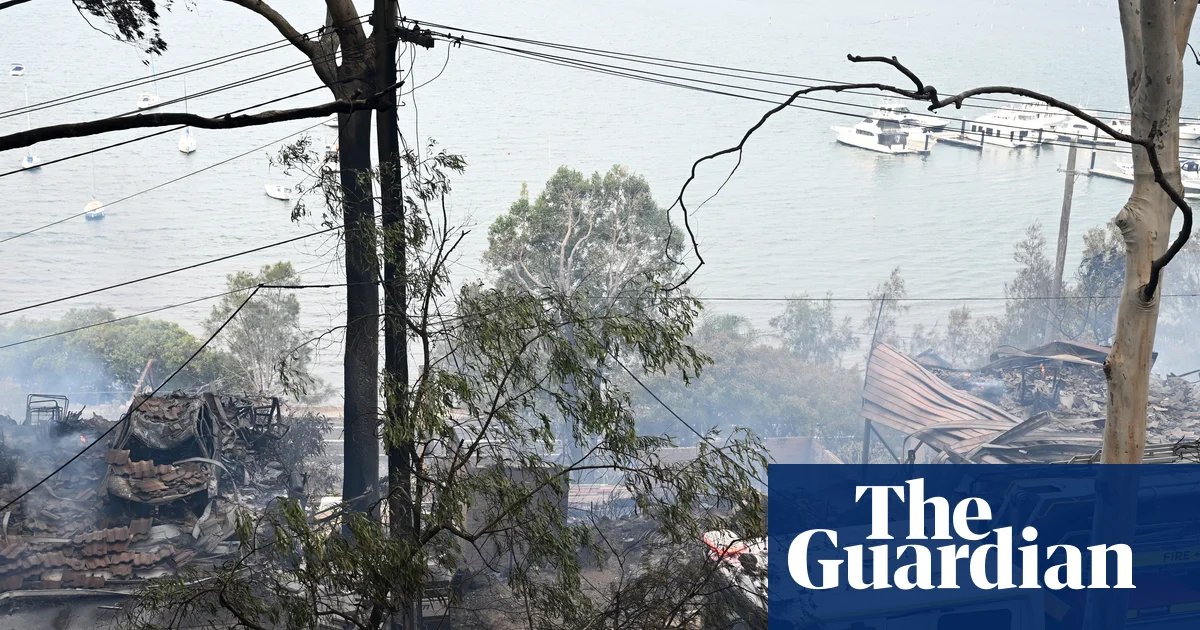
The prime minister, Anthony Albanese, has warned of a “difficult” summer bushfire season ahead, as a natural disaster is declared in parts of New South Wales and crews battling more than 70 fires brace for unfavourable winds on Sunday.
The most destructive blaze – an out-of-control bushfire at Koolewong, not far from built-up areas of the Central Coast – destroyed more than 12 homes on Saturday.
Another four homes were lost at Bulahdelah on the mid-north coast.
Of the active fires, 20 are uncontained. A cool change is forecast to arrive from Sunday morning but forecasters have warned that could create unfavourable conditions, such as strong winds and possible lightning strikes, in places where fires remain out of control.
“We’re not out of the woods yet,” Rural Fire Service deputy commissioner, Ben Millington, said.
“We’ve still got that southerly change come through and that’s where our focus continues to be.”
Sign up: AU Breaking News email
The natural disaster declaration activates support measures for residents, businesses, primary producers and councils. People whose homes have been damaged may be eligible for immediate financial help as well as clean-up, rebuilding and recovery assistance.
The NSW government’s natural disaster declaration applies to the LGAs of:
-
Central Coast
-
Mid Coast
-
Upper Hunter
-
Muswellbrook
-
Warrumbungle
-
Dubbo
Support has been made available under the joint commonwealth-state Disaster Recovery Funding Arrangements (DRFA).
Senior meteorologist Dean Narramore said the strong winds were expected to last for a few hours on Sunday but cooler conditions and more air moisture would follow.
On Sunday morning, authorities issued an emergency warning due to an uncontained bushfire at Redhead, south of Newcastle. Residents were told it was too late to leave and were urged to seek shelter. The warning was later downgraded.
Albanese, speaking on the ABC Insiders program on Sunday morning soon after visiting the Emergency Management Australia headquarters, said it had been fortunate there was no loss of life, which is “always the priority”.
“So this summer of course, like all summers that would appear in recent times, is going to be a difficult one,” he said.
“But New South Wales in particular has a range of pre-conditions if you like for being quite a difficult one.”
The NSW premier, Chris Minns, said the Koolewong fire on the Central Coast would have damaged more homes but for the work of firefighters.
“Just to put it in perspective, the fire embers jumped a stretch of water over a kilometre long,” he told ABC TV.
Damage assessment teams were on the ground on Sunday, along with investigators from NSW Police and the RFS, to determine the cause of the blaze.
Federal and state disaster assistance funding has been activated for Central Coast, mid coast, upper Hunter, Muswellbrook, Warrumbungle and Dubbo.
The declarations activate support measures for residents, businesses, primary producers and councils.
“While we continue to contain the fires that have impacted communities across NSW, our priority is also to support those people whose homes and livelihoods have been impacted,” NSW recovery minister, Janelle Saffin, said.
Temperatures are expected to ease from Sunday for most of NSW and southern Australia, although the heat will build across northern Australia and WA. Hot conditions will return to much of the country early in the week.
Elsewhere, several bushfires are burning in Tasmania.
More than a dozen homes and shacks, outbuildings and cars were damaged and two firefighters were injured fighting an out-of-control fire at Dolphin Sands on Tasmania’s east coast on Friday.
The fire has since been contained, although it’s not safe for residents to return as access to the area remains dangerous.