dailynewsnblog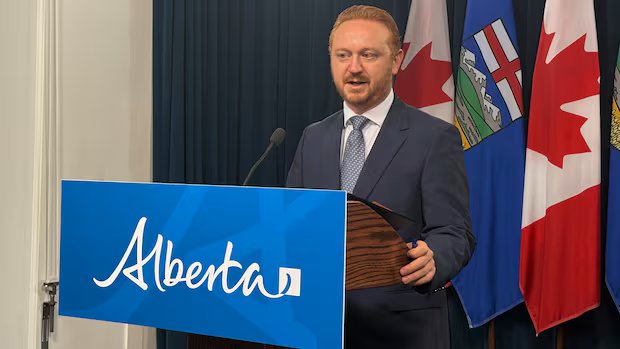

Listen to this article
Estimated 4 minutes
The audio version of this article is generated by text-to-speech, a technology based on artificial intelligence.
The provincial government is proposing sweeping changes to citizen-led referendum questions that could put a stop to an active court case about whether it’s constitutional to ask Albertans if they agree with separating from Canada.
Bill 14, introduced Thursday by Justice Minister Mickey Amery, transfers powers from the chief electoral officer to the minister when deciding whether citizen petition initiatives should proceed.
It also includes an amendment to discontinue any court proceeding brought by the chief electoral officer.
The legislation comes just weeks after Court of King’s Bench Justice Colin Feasby heard arguments about a question that chief electoral officer Gordon McClure referred to the courts, seeking an opinion on its constitutionality. The judge’s decision is supposed to be issued in the coming weeks.
Amery said the changes are about creating a “permissive environment” for Albertans trying to bring referendum questions.
He said the court case currently underway “may or may not continue.”
“The reality is that the court’s entitled to make a decision on any question put to it, independent of what we’re doing here.”
If Bill 14 is passed, only the minister would be able to refer a citizen referendum question to the courts. That power currently rests with the chief electoral officer.
The legislation also amends the Citizen Initiative Act to remove the provision that proposals can’t contravene the Constitution or exceed the jurisdiction of the legislature.
Any citizen initiative petition that hasn’t been issued by the time the amendments take effect will be quashed. But Bill 14 allows the applicants to resubmit within 30 days without paying another fee.
Two citizen petitions — one on whether Albertans agree the province should remain in Canada, and one asking if the province should stop allocating public funds to independent or private schools — have been issued by Elections Alberta.
Changes to election rules
Bill 14 also proposes to restrict the names of political parties, making it so they won’t be allowed to register using “a word or phrase associated with” another party.
There is still some discretion left to the chief electoral officer, but the bill contains a list of words and phrases that can’t be used. These include: conservative, advantage, communist, democratic, green, independence, liberal, pro-life, reform, Republican, solidarity and wild rose.
Amery said the changes are aimed at stopping efforts like the one that saw more than 200 candidates listed on the federal byelection ballot for Battle River-Crowfoot this year.
“Some folks out there want to confuse people into voting for them based on the name ‘conservative,’ but this is not a partisan issue,” he said.
“It would be no different than a party coming forward and seeking to register a name ‘The Alberta Democrats’ or “the New Liberals’ or ‘the Greenest Party.’ This is not what we want for the landscape here in Alberta.”
Changes affecting Alberta’s legal community
The legislation also includes specific changes that would curtail the type of training the province’s legal regulator can mandate for lawyers.
The Law Society of Alberta will be restricted to requiring a law degree or qualification certificate, bar admission course and training imposed as a result of disciplinary proceedings as mandatory education for practising lawyers.
Any mandatory training also has to comply with the requirements of the government’s Regulated Professions Neutrality Act, which, among other changes, says regulators can’t require “cultural competency, unconscious bias, or diversity, equity and inclusion training.”
Amendments to the province’s Legal Profession Act would also make it so the province’s attorney general — a role held by the justice minister — is immune from sanctions for actions they take that are “part of their official duties.”
Appeals of Law Society disciplinary decisions would also be heard by the Court of King’s Bench, rather than a 24-member governance board made up of other lawyers known as Benchers.