dailynewsnblog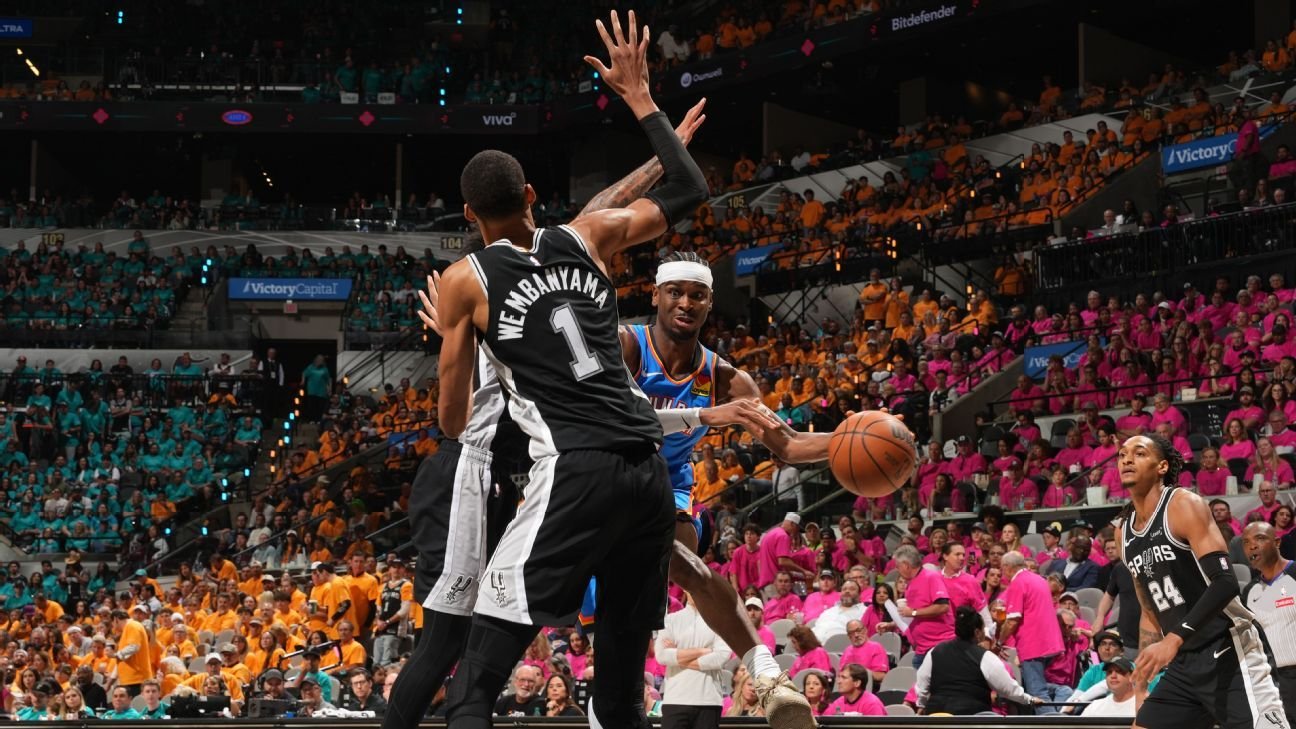
-

Baxter Holmes
Multiple Authors
ON THE LEFT block, just a short skip from the rim, Shai Gilgeous-Alexander found something fleeting, something rare, something that appeared to be a glitch in the San Antonio Spurs’ vise grip defense that had hounded him all night with ferocious double-teams:
A wide-open look.
With 8:30 remaining in the fourth quarter of Game 1 of the Western Conference finals, the Oklahoma City Thunder guard had snuck behind the defensive wall and seemed primed to score his easiest points of the night.
Then something strange happened.
Gilgeous-Alexander began his shooting motion, while Spurs’ star center Victor Wembanyama — who stands 7-foot-4 inches tall and possesses a mind-boggling 8-foot wingspan — stood a few feet away, beneath the rim, resigned to the fact that it was too late to try to block the shot, much less even contest it.
Still, he raised one of his cartoonishly long arms, his eyes tracking the ball toward the basket.
The ball barely grazed the side of the rim, and Wembanyama devoured the rebound. Gilgeous-Alexander tried to wrestle the ball from Wembanyama, who laughed in return at a player who is nearly a foot shorter.
In the Spurs’ nail-biting 122-115 double-overtime win, the play amounted to a forgettable footnote, especially given Wembanyama’s otherworldly stat line: 41 points and 24 rebounds. In the box score, it would register as nothing more than a missed shot and a rebound.
But the play itself marked one of numerous instances that take place throughout the course of a game when Wembanyama’s mere presence evokes something analytics staffers across the league told ESPN that they struggle to accurately quantify.
It represents what might well be Wembanyama’s greatest and most dominant trait, these analytics staffers say.
“As long as I’ve been in the NBA, I think it’s something that we’ve always talked about,” one Western Conference analytics staffer told ESPN.
“How do you measure fear?”
IN THE CATWALKS above the court in all 30 arenas across the NBA, 20 high-tech cameras track 29 points on every player’s body 60 times per second throughout every game, providing billions of data points throughout every season.
That player tracking data is then fed into advanced artificial intelligence and machine learning algorithms to generate statistics that go far beyond the typical box score.
Today, analytics staffers say they’re able to deduce more than ever about the intricacies of the game, especially on offense. But they say defensive impact remains a comparative mystery, where schematic nuances can cloud accurate measurement.
“On defense, you could do everything right and the guy could make an impossible shot on you,” the Western Conference analytics staffer said. “You could do everything wrong and the guy could miss a very easy shot. But how do you determine who was most responsible for that?”
A defensive player could have a high blow-by rate, one Eastern Conference analytics staffer said, meaning players he is guarding tend to “blow by” him toward the lane. But perhaps that rate is a product of a defensive scheme designed to run shooters off the 3-point line and funnel them toward a shot-blocking center in the paint.
While starring for the University of San Francisco in the 1950s, Bill Russell became the first player to utilize the blocked shot as a defensive weapon.
First, Russell blocked his teammates’ shots in practice to the point that some stopped driving through the lane at all. Then he did the same to opponents, who, after getting their shots blocked a few times, began avoiding him too. (And Russell blocked 13 in his first varsity game, still a USF single-game record.)
“The frustration was amazing,” the late Mike Preaseau, a former USF forward, once told ESPN. “They didn’t understand what was happening to them.”
That same trend would continue through the decades — with great shot blockers not only swatting shots but deterring them from ever being taken.
“Psychologically, you have to try to make the offensive player question what he’s doing,” Russell once said. “‘Will this work? Can I make this shot?’ You have to create doubts.”
That psychological edge has held ever since.
THIS ELEMENT OF intimidation has arguably never been more pronounced than with Wembanyama, who led the league in blocks for a third straight season and this campaign, at just 22, became the first unanimous Defensive Player of the Year in league history.
“You talk about guys that change shots. He literally negates guys even shooting the ball,” Spurs guard De’Aaron Fox said in late April. “They’ll see him in there and dribble the ball out or kick out. He changes the whole dynamic of your defense, and he changes the dynamic of other teams’ offense.”
Now in his first postseason, Wembanyama set an NBA playoff record with 12 blocks in a single playoff game and impacted countless other shots during his team’s second-round series against the Minnesota Timberwolves.
“Defensively, man, he’s incredible,” Wolves guard Anthony Edwards said of Wembanyama. “He changes every shot at the rim, he goes to the rim every time after every block, whether it’s goaltending or not, he’s going to go up and challenge it. It’s tough.”
There are ways teams account for Wembanyama’s most dangerous — but invisible — skill.
They examine how many layups opponents attempt against the Spurs — and how that number shrinks when Wembemyama is on the floor. (When Wembanyama was on the court in the regular season, teams averaged 25.7 layups attempted per 100 possessions, three fewer than top-ranked Oklahoma City.)
They also look at the average distance opponents attempt their shots from against the Spurs — and especially how that distance increases when Wembemyama is playing. (The average field-goal-attempt distance from San Antonio’s opponents this season came 14.9 feet away from the basket, 22nd farthest in the NBA. But when Wembanyama was on the floor, that average grew to 15.8 feet, which ranked No. 1.)
Teams also can calculate more recent developments in advanced analytics, such as the league’s expected field goal percentage (which helps determine the odds of a shot going in based on its location) and its defensive pressure score (which measures the amount of pressure a defensive player applies on an offensive player).
Those numbers all clearly tell the same story: at just how much Wembemyama squeezes offenses to his will. Still, for all the ways that teams can quantify Wembanyama’s impact, there are even more that remain a mystery — where, at least for now, only the eye can see them.
“Everyone likes pointing out the videos where guys drive into the paint and then just dribble it out,” the Eastern Conference analytics staffer said. “I think it’s even more than that. I think it’s whether they drive in the first place.
“They’ve got a menu in their head of, ‘This is what I can do in this possession — and driving to the rim is just not on the menu.”
In other words, multiple analytics staffers say, it’s nearly impossible to account for plays Wembanyama prevented from ever happening.
“What he does best,” the Eastern Conference analytics staffer said of Wembanyama, “is hard to quantify.”
WEMBANYAMA’S UNPRECEDENTED ABILITY to spread fear across the half court is what makes him a singular defensive presence, and it’s something that league observers of all stripes notice.
He is not, of course, the first giant to play in the NBA. He isn’t even the tallest. Gheorghe Mureșan and Manute Bol were each 7-foot-7, three inches taller.
Tacko Fall, Yao Ming and Shawn Bradley were all 7-foot-6.
Four other players were an inch taller than Wembanyama, and five others were just as tall.
“Those guys were all elite, elite rim protectors,” one analytics staffer said, “but … his deterrence expands all over the court because he’s way more mobile and fluid than any of those guys.”
Hall of Fame guard Dwyane Wade, who has called some of Wembanyama’s games for Amazon Prime this season, agrees.
“Most guys, if they have the height or the length, they don’t have the agility or the quickness to move side to side,” Wade told ESPN. “Then, if they do, they’re not smart enough to not just jump. He has all those things. He also has the patience. He allows for the ball to be released before he jumps. He does it all.”
Just ask former NBA coach Tom Thibodeau, who is considered one of the greatest defensive minds in the history of the game.
“So much of today’s offense is predicated upon attacking the rim and then making your read at the rim, whether you can get all the way there and lay it in or spray it out for the 3,” Thibodeau told ESPN.
“And he deters you from even going in there. As a defender, if you can get the offense to react to you, you have the advantage. And he’s a defense unto himself. … He’s got you guessing all the time. Is he coming? Is he not coming? You’re always looking.”
Or ask ex-NBA coach Mike D’Antoni, who is considered one of the greatest offensive minds in the history of the game.
“If you’re just going to play traditionally and try to get to the rim,” D’Antoni told ESPN, “you’ve got no chance.”
D’Antoni says arguably the biggest problem that Wembanyama poses is that when he’s guarding a pick-and-roll, he can remain behind the play and use his height and length to still impact what the offensive player might do.
“We always teach to be up with the screen, but he doesn’t have to be there,” D’Antoni said. “He can be back and impact the shot anyway. He’s the only guy who can do that. You can’t teach that, and you can’t get around that.
“That’s why he’s going to be MVP for the next 10 years.”
Calling some of Wembanyama’s games has led Wade to appreciate his play even more.
“We talk about [Michael] Jordan and LeBron [James] and all them guys — we always talk about their accomplishments,” Wade said. “We could stop right now with Wemby and say we saw someone who’s actually really good at everything. He has no weaknesses. It is incredible. And so, yes, on the defensive end of the floor, he’s just as dominant as he is on the offensive end of the floor. He has total dominance on both sides of the floor.”
As for the part of his dominance we can’t quantify?
“We’ve never seen guys that want to attack the basket, that want to score, that want to shoot, look at Wemby and try to size him up and they can’t beat him left, they can’t beat him right, they can’t go over top,” Wade said.
“They just go somewhere else.”