dailynewsnblog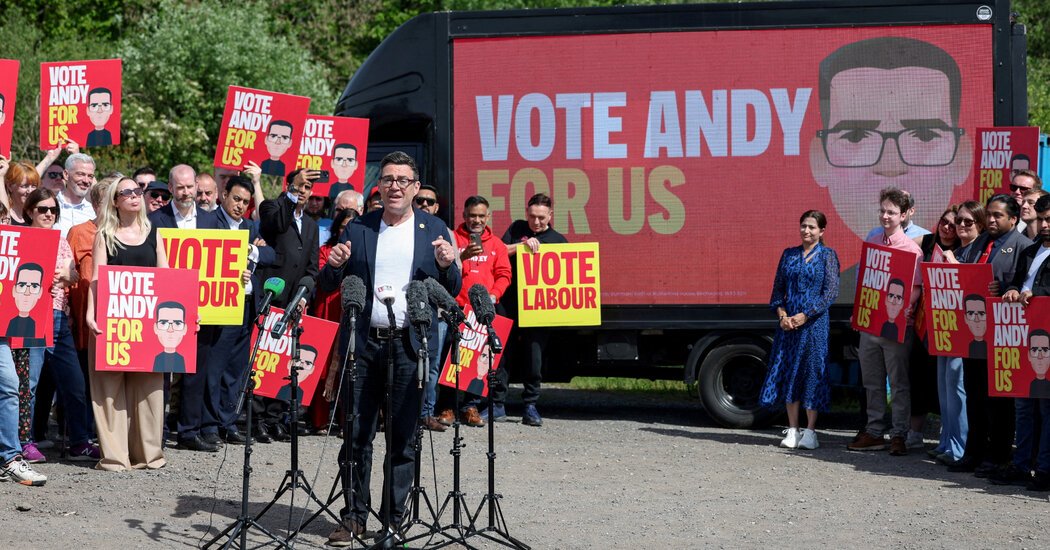
It would have seemed hard to imagine a few months ago that residents of Ashton-in-Makerfield, a former coal mining town in the north of England, might play a central role in toppling Britain’s prime minister.
Yet that possibility was on just about everyone’s mind last week at the town’s main coffee shop, down the road from a sports club where Andy Burnham, the mayor of Greater Manchester, had set up campaign headquarters for his shot at a seat in Parliament.
If he wins a June 18 special election, Mr. Burnham is expected to challenge Prime Minister Keir Starmer for the leadership of the governing Labour Party and the country. Mr. Starmer is so unpopular that many of the town’s residents believe Mr. Burnham would have little trouble defeating him in an intraparty contest, which would also transfer control of Downing Street.
“Let’s face it, I think that’s the only reason he’s doing it — so he can challenge Starmer,” Paul Kirkwood, a retired logistics operations manager and lifelong Labour voter, said of Mr. Burnham. “We need a change of direction, and we’re not going to get it with Starmer.”
The outcome in Makerfield could convulse Britain’s government at a time of conflict around the world and deep concerns domestically about the country’s sagging economy, the cost of living, youth unemployment and health care. Many Labour voters appear to have concluded that a change at the top of their party is required to alter that trajectory.
Makerfield will also test Reform U.K., a right-wing populist party led by Nigel Farage that has become a major political force. In local elections across much of Britain last month, Reform won more than 1,400 seats on municipal councils by opposing immigration, taxes and regulation. It only won about 26 percent of the vote overall, but several other parties split the rest of the ballots.
Mr. Farage has promised to pour resources into helping Robert Kenyon, Reform’s candidate in Makerfield, defeat Mr. Burnham. Mr. Kenyon, a self-employed plumber, is hoping to tap into a deep well of anti-Starmer sentiment that helped Reform candidates win 24 out of the 25 local councilor seats in Makerfield last month.
At the Market Tavern in Hindley, about a 15-minute drive from Ashton-in-Makerfield, Mike Jolley said he was a lifelong Labour voter but planned to cast a ballot for Reform because of his dislike of the prime minister and the policies his government had pursued.
“He just doesn’t think about the working people,” Mr. Jolley, an engineer, said last week of Mr. Starmer over a pint of beer. “He’s not interested in those working people, whether you are self-employed or not.”
Mr. Jolley said he was concerned about the numbers of illegal immigrants in Britain and said Mr. Starmer’s government was too willing to provide housing and other benefits to asylum seekers when native-born British citizens were struggling to make ends meet.
“I’m not saying Reform are perfect, and I’m not saying the Reform candidate is perfect,” he said. “But if I vote for Burnham, then we’re just going to get just the same, yeah?”
In surveys, many Britons still complain about immigration, although official data shows a sharp decline in arrivals in recent years. That is the result of tougher rules announced at the end of the previous Conservative government, which have been extended by Labour since it took power two years ago. This month, the Office for National Statistics reported that net migration had fallen to its lowest level since 2012, excluding the pandemic.
The campaign in Makerfield has been in high gear since it was announced on May 20, when the area’s previous representative — a 32-year-old Labour lawmaker — stepped down so Mr. Burnham could run. In addition to Mr. Burnham and Mr. Kenyon, candidates are running from other parties including the Conservatives, the Greens, the Liberal Democrats and the far-right Restore Britain.
But most attention is on the battle between Mr. Burnham — a one-time member of Parliament, and a cabinet minister in a previous Labour government — and Mr. Kenyon, a member of the area’s municipal council.
The candidates have focused on knocking on doors in the district and, save for a few interviews with publications including the main local newspaper, The Manchester Evening News, have bypassed much of the press by posting videos on social media.
“A wet Monday,” Mr. Burnham said in one of the short videos he posts each day. “Sunblock definitely not needed this week. But the wetness more than compensated by the warmth on the doorstep. Thanks everybody.”
In one of his videos, Mr. Kenyon told a crowd of supporters that “we’re going to get normal people with common sense and the best intentions,” adding: “Let’s win this election, because this is where we turn the tide.”
Last week, Mr. Burnham and Mr. Kenyon participated with several other candidates in an hourlong television debate on the BBC. Mr. Kenyon faced tough comments about crass remarks he made in the past about women, including once saying in an online post that “I’m sexist.”
“I’d rather have a career politician than a plumber who’s a sexist,” one woman in the audience said. In response, Mr. Kenyon said he would not accept that label but declined to apologize.
“I’ve got nothing but respect for women, you know,” he said. “I think something that was said, 15 years ago, dragged up from an old rugby forum — it’s completely taken out of context. Let’s say I’ve made mistakes and said things years ago that I wouldn’t say now.”
Alexandra Meakin, a professor of British politics at the University of Leeds, said the criticism of Mr. Kenyon “shows that the Teflon coating that seems to apply to Farage does not automatically transfer to anyone with a Reform rosette.”
She said Mr. Burnham seemed poised to consolidate Makerfield’s progressive vote, while more conservative voters appeared likely to split between Reform and Restore, a party led by a Reform defector, Rupert Lowe, who fell out with Mr. Farage last year.
It is that battle, she said, “that may prove decisive.”
Mr. Burnham came under criticism at the debate for playing coy about whether he would challenge Mr. Starmer. Several members of the audience noted that the special election was taking place only because Mr. Burnham wanted to become prime minister. (Only a member of Parliament from the governing party can vie for the leadership. A Reform U.K. victory in Makerfield would be ominous for Labour, but it would not force Mr. Starmer into a contest.)
After repeatedly insisting that he was focused on Makerfield, Mr. Burnham relented and said he would join a contest to oust Mr. Starmer if he won there.
“I can’t do anything unless I’m lucky enough to get the support of people here,” he said. “But if I get your support, I would seek to represent you at the highest possible level and give this constituency maximum power and influence.”
First, though, he has to win an election in a community that appears divided.
At a coffee shop in Ashton-in-Makerfield, David Babbington said he planned to vote for Mr. Burnham, in part because he doesn’t like Mr. Farage and Reform, but also to change the governing party for the better.
“I think if Andy Burnham gets into Parliament, he’ll be a better Labour. He could change the Labour Party in a big way.”
But not far away, at the Golden Lion pub, David Edwards said he would vote for Mr. Kenyon because he thinks Reform is more serious about stopping the flow of illegal immigrants, some of whom arrive in Britain in small boats.
“Why are they coming all the way through Europe from where they come from on boats, on trains and wagons?” he said. “And then they try to come across here for free, for free benefits when this island’s not big enough to sustain the people that already live here.”