dailynewsnblog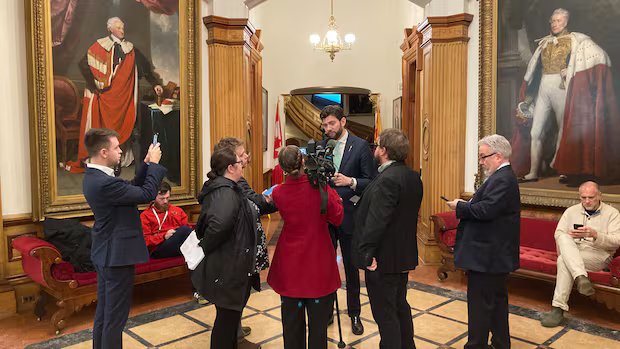
You can say this about the 1st Earl of Sheffield and Lord Glenelg: they had a good run in New Brunswick for two long-dead, nearly unknown British officials.
Their life-sized portraits hung in the rotunda of the Legislative Assembly Building for decades, dominating the space — a striking visual indicator of their supposed importance.
Now they’re gone.
The portraits were recently removed and put into storage after a decision by the legislative administration committee, an all-party group of MLAs that oversees the building.
The committee wanted to “modernize the entrance of the legislative assembly, to put more emphasis on the MLAs that are working here, that have been working here, to put more emphasis on the people who represent all New Brunswickers,” said Speaker Francine Landry.
To that end, the portraits have been replaced with MLA composites — framed collections of photos of members elected in 2020 and 2024 — like those that have hung on the other two walls of the rotunda.

Downplaying New Brunswick’s colonial history is a departure for the legislature.
Portraits of past monarchs and other royals are displayed in the main chamber and the upstairs committee room.
Lieutenant-governors — symbolizing the continuing role of the Crown in our constitutional system of government — line the corridor that connects the rotunda to the landmark spiral staircase toward the back of the building and continue partway up those stairs.
In contrast, smaller photos of premiers are tucked away just outside the main chamber, in a corridor that the public can’t access.

Speaker says goal was to ‘modernize’ assembly, focus on elected members.
A century-and-a half’s worth of those MLA composites adorn the walls of the disused basement cafeteria and other downstairs spaces.
Landry said visitors to the legislature are often curious about who represents them, which is why the two most recent composites have replaced Sheffield and Glenelg in the line of sight of anyone using the main entrance.

“These buildings are part of our history as New Brunswickers, and we have to make sure … that people recognize that this place is their place, that it is the house of the people of New Brunswick,” she said.
“As well we need them to know the history behind the building, and all the people that have contributed to making the democracy that we have and the society that we have in New Brunswick.”
Asked if the committee’s decision was unanimous, the Speaker said the committee makes decisions by consensus but “the historical context may not have been unanimously accepted” by some of the MLAs.
“We don’t put history aside. We will try to find a better place and put these pictures and explain the pictures in the historic context.”
Sheffield and Glenelg were not always seen as forgettable, or even optional.
“These noblemen deserve to be remembered not just as pictures hanging on the wall, but as men who faced and solved great problems,” says an unsigned and undated research paper on the portraits in the legislative library.
John Baker Holroyd, 1st Earl of Sheffield, fought against changes to the Navigations Acts, pieces of British trade legislation.

Proposed changes to the acts in the late 1700s would have opened freer trade with the United States, putting New Brunswick’s timber exports at risk.
A grateful assembly commissioned the portrait, which arrived in 1806.
The contribution of Charles Grant, Lord Glenelg, also revolved around the timber trade.
In 1837 he granted control over Crown lands revenue — half of New Brunswick’s revenue — to the assembly, which was later seen as an important step toward responsible government.
But University of New Brunswick historian Angela Tozer, an expert on 19th-century colonial history and debt financing, regards the two men as part of a power structure that continues to this day.
“These colonies were able to fund themselves through this mass appropriation of Indigenous territory and then going to banks in England to develop things like the timber trade,” she said.
In her view, that dispossession remains the basis for much of the province’s present-day resource economy.
“The colonial relationship, it’s not something that is in the past. It’s very much ongoing.”
Landry said the two portraits may end up being displayed elsewhere in the legislature.
“If somehow they can be used somewhere else, they will.”
Landry also said the building needs to be more inclusive, representing the province’s diversity, including the province’s various regions, First Nations and women who have been underrepresented on the walls in the past.
Tozer said any conversation along those lines goes far beyond portraits and needs to reckon with the legacy of colonialism today.
“I do think it is very important to have some sort of discussion linked to these portraits for the general public,” she said.
“I think there needs to be more education about the history and contemporary reality of colonial power dynamics.”