dailynewsnblog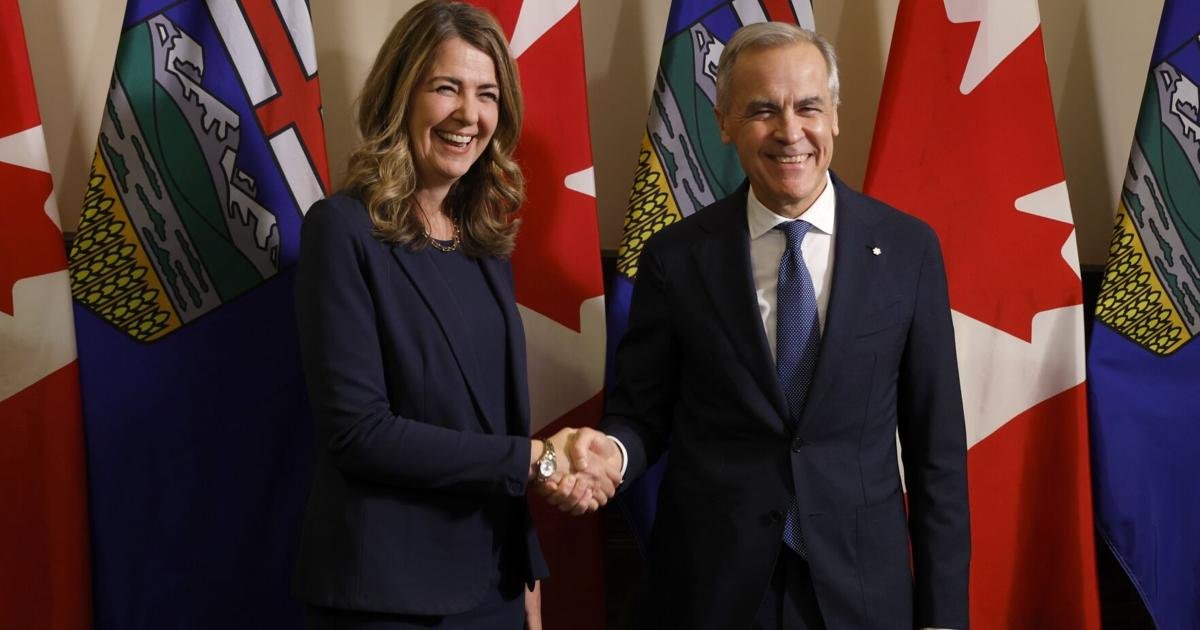
OTTAWA — Prime Minister Mark Carney says hope is not a strategy when confronting global economic and security turmoil.
It also won’t work to confront the twin national unity challenges in Alberta and Quebec that are fomenting.
Alberta Premier Danielle Smith, cornered by separatists in her party’s ranks, will host a referendum on whether the province should remain in Canada or begin the process of splitting the country apart.
(If the answer is no to Canada, it is not clear if Albertans would be asked if it should form a sovereign independent nation with or without the First Nations that oppose it, or join the U.S.)
In Quebec, the Parti Québécois promises a referendum on sovereignty if it wins power in the fall, despite polls showing most Quebecers don’t want that divisive debate right now.
Suddenly, Canada needs a champion with the emotional, legal and political IQ and the passion to speak for national unity.
And it needs it now as the battle for hearts and minds begins.
Privately, some Liberals wonder if Carney — a Western-born and raised former central banker — has the persona for that fight.
Privately, some Conservatives as well wonder if his rival, their leader Pierre Poilievre, has it.
Both federal leaders are bilingual. One is purpose-built for facing global economic crises and driven by an economic agenda to “build, baby, build.” The other is a lifelong politician who lost his own riding last spring and has since seen his leadership bona fides challenged by the defection of four MPs to the Liberals.
When Carney named constitutional lawyer and jurist Louise Arbour as the next governor general, the prime minister was asked how he intends to stop Alberta separatists from winning a referendum.
Canada, he said, is a country where the rule of law will be determinative, so any vote will have to abide by the Clarity Act’s requirements of a clear question and a clear majority — a decision in which Parliament would have a great deal of sway.
That’s a dispassionate reply, relying not just on the letter of the law but on the public’s willingness to abide by it.
Then the prime minister said his government would “continue to act as we have from the start, which is in the spirit of co-operative federalism, making the country work, making it work for Albertans, making it work for Indigenous Peoples, making it work for all Canadians.”
Carney did the same Friday, touting that changes are afoot under his government and “Canada is working” as he responded to Smith’s gambit aimed at saving her political career.
Carney knows full well a referendum risks injecting major economic and political uncertainty at a time when Canada can least afford it, but the prime minister didn’t go the fear route. He pointed out that a better Canada is possible for all Canadians.
That is a hope-as-strategy answer.
Poilievre offered the same Friday, saying he and his party will make the case for a united Canada “through hope. We want Albertans to understand that they can have an even better future in our country.”
Neither the legal arguments nor hope may be enough.
Federalist Quebecers who lived through two painful votes in 1980 and 1995 say there are lessons to be learned for federal leaders.
First, said Stéphane Dion, who was the architect of the Clarity Act as a Liberal cabinet minister, the prime minister must “not be shy to clarify things about the process” that will govern any secession effort.
Second, Dion said in an interview, Carney should listen to B.C. Premier David Eby and never give the sense that Ottawa is “caving to blackmail separatism.”
The third and most profound lesson that Dion stresses is that the federalist side must never grant separatist advocates the “monopoly on pride and courage.”
That’s the passionate emotional argument, the one that must clearly voice the pride of a united Canada, of a province’s place in the country, and the courage to call on citizens to embrace it.
It is an important warning coming from Dion, an academic who penned countless letters and essays in making the intellectual argument against Quebec separation. As intergovernmental affairs minister, Dion led passage of the Clarity Act in 2000 in response to the 1998 Supreme Court of Canada reference ruling on Quebec secession.
Now a diplomat-in-residence at Université de Montréal, Dion said Smith has created a political “mess” with her referendum-on-a-referendum question.
But in his view, her decision does not trigger the Clarity Act, because the question asks Albertans whether they should begin the process of holding a binding legal referendum on separation.
“So, the government of Canada and the House of Commons don’t have to be involved at this point,” said Dion.
However, the lessons of history show now is the time for leaders to step up and be clear on where they stand.
During 1980’s first sovereignty vote in Quebec, “the pro-Canada forces not only won the referendum, they won also the campaign,” said Dion.
“The gap between the ‘yes’ and the ‘no’ increased to the benefit of the ‘no’ during the campaign, and the reason is that prime minister (Pierre) Trudeau said to Quebecers, ‘We are too proud of what we have done with other Canadians to leave it, to abandon it. We are proud Quebecers, proud Canadians.’”
That kind of “very engaging political claim” worked, said Dion.
In 1995, the “no” side was the one that expressed “these values of pride and courage,” said Dion, when the Quebec sovereigntist movement led by Lucien Bouchard captured the zeitgeist, telling Quebecers to “stand up, and for once they will respect us, we will not be on our knees anymore.”
Dion gave the government of the United Kingdom this same advice before a separatist referendum in Scotland, and it wasn’t heeded. Instead, leaders of the no campaign in Scotland campaigned, he said, on “what kind of currency we will use, and, ‘Oh, it’s too uncertain’ — which is true, but it’s not enough.”
Besides economic stability arguments, said Dion, “you need also to make sure that the pride to be British or the pride to be Canadian is at the core of your campaign.”
Dion said Carney is so far taking the right approach, and while he adamantly disagrees with Carney’s effort to help Alberta to build a pipeline, he does not believe the prime minister is ceding to political blackmail. Rather, he said, Carney seems to personally believe a pipeline is the right policy for the country.
As for making the passionate argument, “a clear leader is very important in a referendum,” he said, but that is the approach “everybody should have.”
“Pride and courage should be at the core of your campaign,” he said. “And the fact that Mr. Carney said today, Canada works? It needed to be said.
“We should not give in to the separatist argument that the country does not work.”
There are similarities in the two separatist movements, which both argue the country is broken and should formalize a divorce. It’s not yet clear if one is a greater threat than the other. In Quebec, separatists have formed governments and organized two referenda. In Alberta, they’ve got a foothold in Smith’s United Conservative Party and all but triggered a separation vote.
Liberal MPs are worried about both.
A key difference, said Calgary MP Corey Hogan, is that Quebecers have spent a longer time actually weighing the risks during the course of past votes, whereas in Alberta there is a kind of “prairie brush fire risk.”
By that, he means frustration with the East “becomes the referendum, where you exercise your frustration about everything, just as Brexit became. So the risk’s just different. Obviously, Quebec has a more established separatist movement. That presents risk. Alberta doesn’t, and that presents risk.”
“The best defence against both is just governing well and governing (Canada) for all, making sure that the country works for everybody’s ambitions and interests,” Hogan said in a recent interview.
In Alberta, where Hogan used to run polling for the provincial government, separatist sentiment registered at around 20 per cent in the 1980s. About a year ago, it was about 20 per cent and since then it’s risen, sometimes tracked into the high 20s.
Hogan said that as in Quebec, Alberta’s movement has a strong cultural component. “There is deep-rooted frustration with federal governments in Alberta literally going back to the founding of the province … across Conservative governments, Liberal governments, that the East governs — I’m saying ‘East’ like a Western Canadian — the East governs at best with indifference to the West, and at worst with a kind of malice.”
Hogan believes Carney is the right person to lead the fight. Carney “of course” has an emotional tie to and understanding of Alberta where he grew up, but that “doesn’t mean that he can’t intellectually understand Quebec separatism,” he said. Moreover, “I think it’s a good thing that we have a prime minister who understands a part of the country that is not always well understood.”
For Montreal MP Marc Miller, one of the key lessons from the last two Quebec votes is that the federal government must “not take people for granted” and must offer voters a “positive voice” for Canada.
“They don’t want to see fear-mongering,” he said. “I think we have to be quite honest about what the upside and downside is, and not look at these things through romantic rosy lenses.”
As well, Miller said, federal leaders cannot assume other political entities in provinces will make the case for Canada, and must work to “dispel” the frustrations that citizens are expressing.
In Quebec, for example, he said no one can assume that the federal government can “wash its hands” nor assume “that some provincial iteration of the party or expression of the ideas that we share will pick it up and do the federal work for them.” That, he added, “is wrong thinking, and I think eventually it’ll backfire.”
Quebec City MP Jean-Yves Duclos said Quebec’s past two votes divided families and communities, and left deep economic, social and political scars. Alberta is about to experience those divisions first-hand.
He said the two separatist movements may have differences, but they have one thing in common: a critical failure to recognize the external threat to the country in 2026.
At a time when the world is dividing into factions and blocs, Duclos said, “We have to be more united than we were before.”
Dion said as the debates play out, “The key player is Mr. Carney. He’s the prime minister of Canada. It is his responsibility.
“The last thing a prime minister of Canada wants is to be the last prime minister of a united Canada. It’s the most important duty they have on their shoulders: to be sure that they will transmit to their successor a united country.”