dailynewsnblog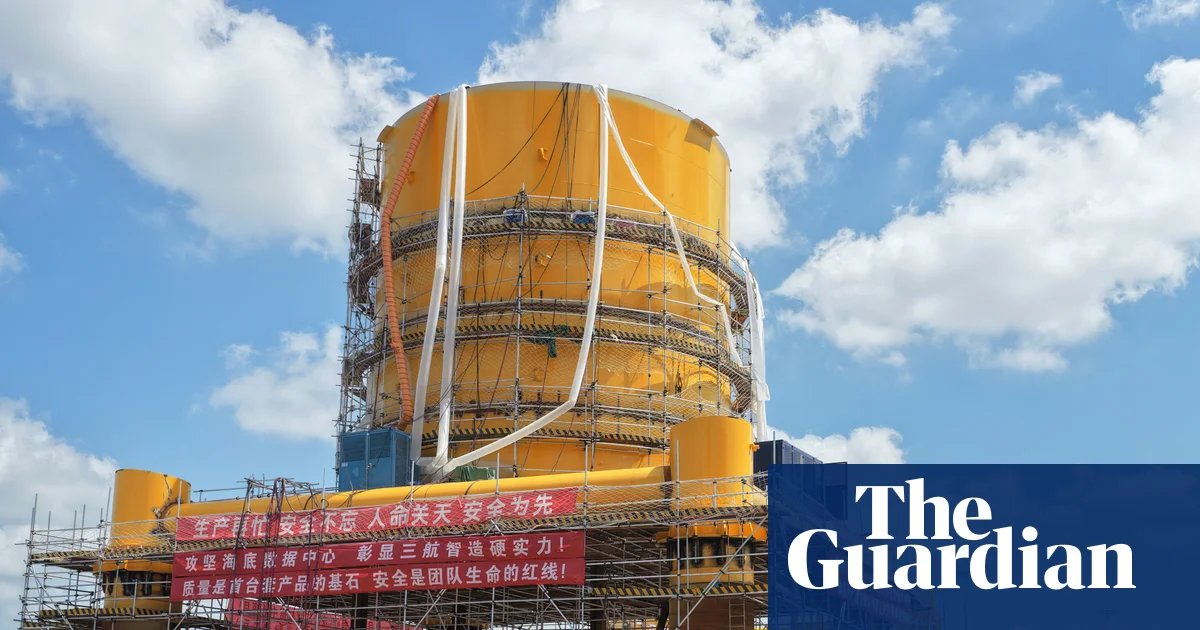
The world’s first wind-powered underwater datacentre has started operations off the coast of Shanghai, as China presses forwards with solutions for energy challenges created by the country’s artificial intelligence boom.
The Shanghai Lingang undersea datacentre demonstration project, which launched in May, has a capacity of 24 megawatts. It is a joint effort between HiCloud Technology and China Communications Construction, a state-owned company.
Located more than 6 miles (10km) off the coast of Shanghai, the datacentre is submerged 10 metres below the surface of the water and is powered by a nearby offshore windfarm. According to the Chinese government, the datacentre reduces power consumption by more than one-fifth compared with land-based datacentres.
That is because as well as being powered by renewable energy, its overall energy demands are less because of the natural cooling effect that comes from being submerged in seawater.
In a traditional, land-based datacentre, anywhere between 25% and 40% of the total electricity demand comes from the need to pipe chilled water around the servers to prevent them from overheating.
Traditional datacentres, known as the physical backbone of AI, have also come under scrutiny because of how much water they use. Having datacentres in the sea reduces the need for freshwater supplies.
This week the United Nations University Institute for Water, Environment and Health warned that the water footprint of datacentres could reach 9.3tn litres by 2030 – enough to service the annual domestic water needs of all 1.3 billion residents of sub-Saharan Africa.
HiCloud launched the world’s first commercial underwater datacentre in Hainan, a tropical island in southern China, in 2023. But the Shanghai launch is the first project to be powered by offshore wind. The farm is just about visible off the coast of Lingang, a hi-tech, free-trade zone in eastern Shanghai that is also home to a Tesla gigafactory.
China was not the first country to experiment with building datacentres underwater to make them more efficient. In 2018, Microsoft launched a pilot in the waters around Orkney in Scotland. Two years later, the company reported promising results but progress has since stalled.
“Microsoft was earlier in proving the concept, while China moved further on commercial deployment because it was able to bring together market demand, industrial capability, marine engineering and policy support more quickly into a commercial project,” said Dr Hanjiang Dong of Hong Kong Polytechnic University.
China has made support for AI a central pillar of its economic and development strategy. Last year, it released an AI action plan that called for the acceleration of datacentre construction. The government has also pledged that clean energy supplies for AI infrastructure will be “significantly increased” by 2030.
The Shanghai Lingang datacentre received 1.6bn yuan of investment (£177m), according to the Chinese government.
Underwater datacentres also create some risks for marine ecosystems, such as by disturbing sediments or heating the seawater. Experts said these risks were most likely manageable but would require further monitoring.
Prof Rick Stafford, a marine biologist at Bournemouth University, said: “An underwater datacentre is likely a good idea. While the cooling using seawater will result in some localised elevated temperatures, these will not be far reaching.”
Additional research by Yu-chen Li