dailynewsnblog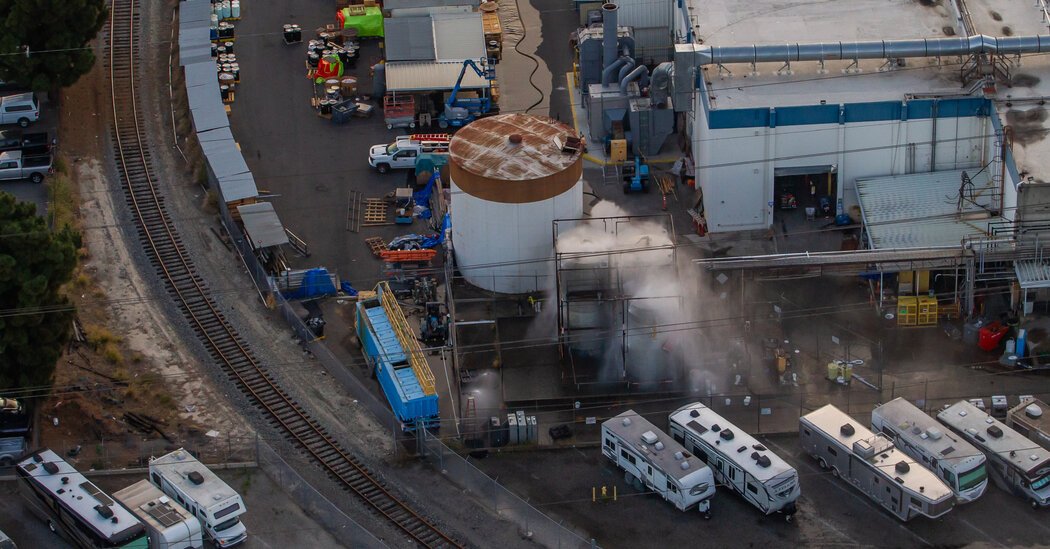
An industrial tank containing about 7,000 gallons of a highly flammable toxic chemical remains on the brink of explosion or rupture in Southern California for the fourth consecutive day, keeping tens of thousands out of their homes.
The tank is at a plant in Garden Grove that belongs to GKN Aerospace, a company based in the United Kingdom that manufactures aircraft components.
The tank became increasingly pressurized on Thursday, releasing gas that could trigger an explosion.
Firefighters responded, dousing the tank with copious amounts of water in an attempt to cool it, but GKN Aerospace’s team was unable to inject a neutralizing agent to reduce the chemical’s instability because of a failed valve.
“No one has ever had this situation before because the chemical is so volatile,” said TJ McGovern, the interim fire chief of the Orange County Fire Authority, who called the situation “unprecedented.”
The chemical inside the tank, methyl methacrylate, is used in the manufacture of resins and acrylic plastics, most notably plexiglass.
According to the Environmental Protection Agency, exposure to methyl methacrylate can irritate the eyes and skin and make it difficult to breathe, among other symptoms. Birth defects have appeared in animals exposed to the chemical.
On Saturday, local fire officials said the temperature inside the tank had risen more than 20 degrees, and the temperature continues to fluctuate at around 90 degrees, according to Chief McGovern.
There is fear of a “thermal runaway,” which could further generate heat, build pressure and cause a blast, said Elias Picazo, an assistant professor of chemistry at the University of California.
Alternatively, he said, a tank failure — in which the tank ruptures but does not necessarily explode — could lead to a controlled leak that could then be neutralized.
“I think the temperature within the tank has been steadily increasing and that’s indicative that the reaction is moving forward,” he said.
It is possible, officials said on Saturday, that the increase in temperature is occurring because the liquid inside the tank is solidifying. If so, and if the tank holds, that could make a rupture less likely.
A specialized team composed of officials from the fire departments in Los Angeles, San Bernardino County, Orange County and Long Beach were working on alternative solutions to prevent the tank from breaching, Chief McGovern said on Saturday. He did not provide details.
Gov. Gavin Newsom of California declared a state of emergency in Orange County on Saturday. More than 40,000 residents in the surrounding areas are under evacuation orders.
“We have a lot of citizens displaced and, when it’s safe to do, one of the things we want to do is to get them back in their homes,” Chief McGovern said in a phone interview.
Erika Ocana, who lives about a five-minute walk from the plant, evacuated on Friday with her four children, three dogs and a cat.
“I’m just thinking like, what about the ones that are really close to it, what about the houses, what’s going to happen?” she said.
In a video posted to Facebook, Dr. Jason Low of the South Coast Air Quality Management District detailed the air measurements being taken in the community near the facility.
On Friday, the regional agency had begun measuring pollutant levels around the evacuation zone. Dr. Low said officials were “happy to report that levels are completely normal in our measurements.”
That agency has worked with the E.P.A. to deploy 24 monitors to continue the air measurements.
“We’re happy to report we have not seen any contaminants in those monitoring stations and we’ll continue to do that until the scene is secure,” said Harry Allen, an on-scene coordinator for the E.P.A.