dailynewsnblog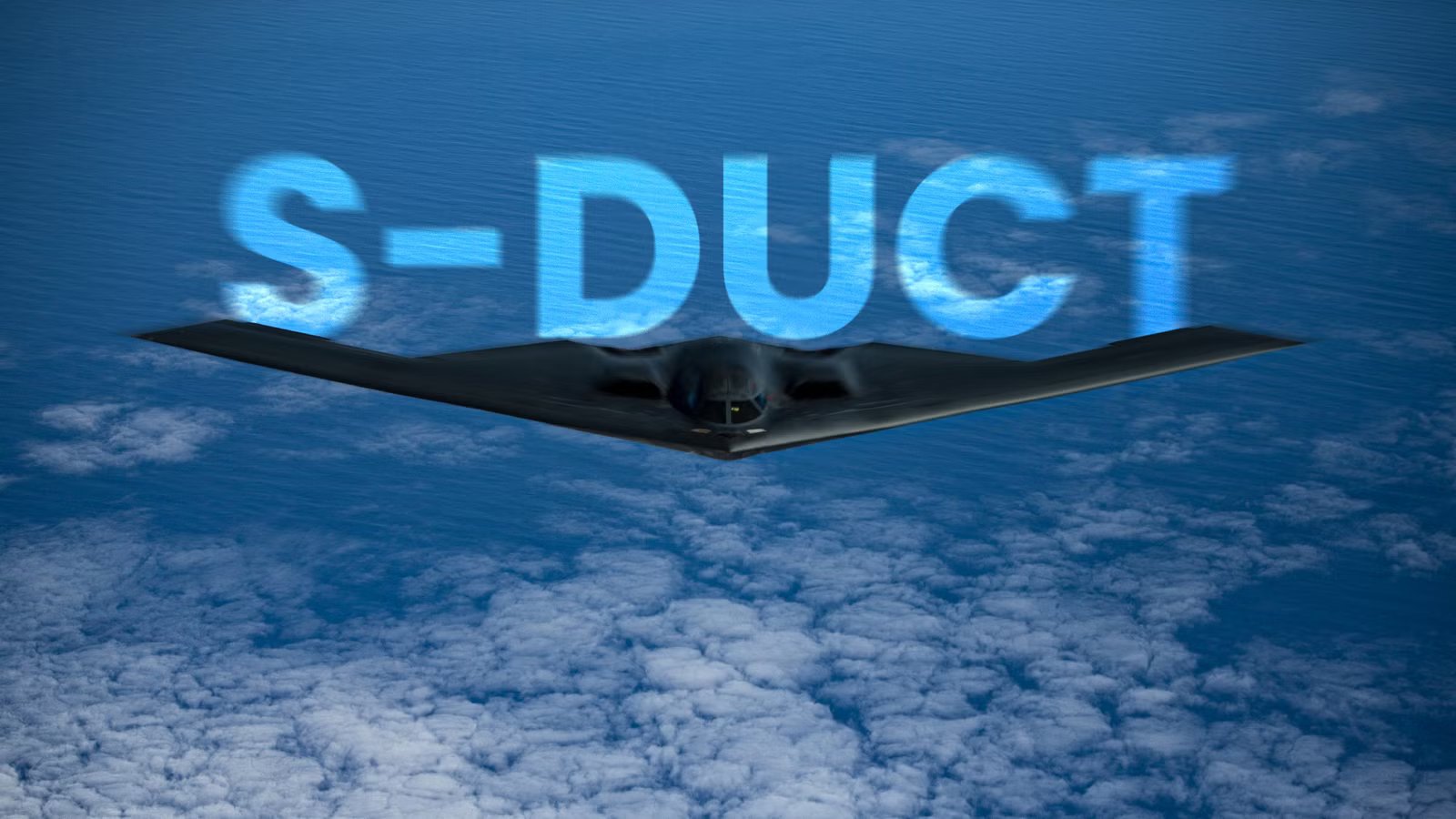
One of the key features of the Northrop B-2 Spirit that helps it reduce its Radar Cross-Section (RCS)is its S-shaped serpentine engine ducts. To a lesser extent, they also aid in the aircraft’s Infrared (IR) or thermal signature. While ducts were a major leap in stealth engine design when they entered service on the B-2, they are now expected on stealth aircraft. The F-22 Raptor, F-35 Lightning II, the Chengdu J-20, and the B-21 Raider all have them.
The succeeding Northrop Grumman B-21 Raider is also incorporating S-Shaped ducts to reduce its RCS. The B-21’s exhaust system represents more than a generation’s worth of refined stealth aircraft design, improved engine designs, better materials, advanced computer simulations, and more. The B-21 is a generational leap over the B-2 and is more than a simple upgrade. The exhaust management systems on these aircraft are a core part of what enables them to penetrate heavily defended airspace and carry out precision strikes on high-value targets.
Stealth Is More Than RCS

Reducing an aircraft’s radar cross-section (RCS) is the most famous aspect of stealth, but it is only one part of it. Even RCS is a complex topic, as radar return values depend on what aspect the aircraft is being observed (e.g., from the front or rear), how well-maintained the radar absorbent coating is, what frequencies the radar is using, etc. Stealth includes other factors like making the aircraft harder to see with the naked eye against the sky and more difficult to hear for the naked ear.
One of the most important, often unsung, aspects of stealth is electronic emissions control. This is one of the major weaknesses of Russian fighter jets like the Su-35, which are equipped with powerful PESA radars that light up like a giant flashlight visible to other aircraft. Networking with off-board platforms and passive sensors is an important aspect of a stealth aircraft.
Stealth is not just hiding; it is also fighting back. Stealth aircraft can jam radars, and they can flood the returns with virtual decoys. Decoys mean that a radar may be able to see the aircraft, but it can’t distinguish which return is the real target. One of the most important pillars of stealth is managing the infrared (IR) signature. Engines are hot and create hot air that can be detected, tracked, and targeted.
B-2’s Layered Approach To IR Masking

The B-2 was developed in the 1980s and was a marvel of engineering when it entered service in 1997. The aircraft employs multiple methods to reduce its infrared signature, something that was considered almost as important as reducing its RCS. Modern ISRT systems and heat-seeking missiles look for the thermal contrasts created by the hot engine turbine blades, the exhaust gases, the exhaust plume, and even heated skin from air friction.
Some ways the Spirit reduces its IR signature are by placing the engines on top and burying them, mixing and cooling its exhaust, using low-emissivity coatings and paints, remaining subsonic with no afterburner, and even flying at a high altitude. Its exhaust system is perhaps the aircraft’s most important IR feature. The flattened exhaust spreads exhaust through wide exhaust trenches on the upper rear wing surface.
|
Northrop B-2 Spirit (per USAF) |
|
|---|---|
|
Number built |
22 (21 combat coded, 19 remaining) |
|
Powerplant |
4x General Electric F118-GE-100 engines |
|
Entered service |
1997 |
|
Max takeoff weight |
336,500 pounds (152,634 kilograms) |
|
Payload |
60,000 pounds (unclassified) |
Having the exhaust placed above the aircraft also makes them less visible from below. The S-Shaped Engine Ducts also help the B-2 reduce its IR signature, although they also help reduce its RCS. One of the primary types of air-to-air missiles used is infrared/heating-seeking missiles (e.g., AIM-9X Block II). These home in on an aircraft’s engines or the aircraft and are normally used for shorter-range engagements. Another type of homing missile is radar-guided missiles (e.g., AIM-7, AIM-120), which are more effective at longer ranges. Stealth aircraft like the B-2 need to defeat both types.

Here’s Why The Northrop Grumman B-21 Raider Is Replacing The B-2 Spirit
As the B-2 is aging, out of production, and not available in sufficient numbers, the Air Force needs a fresh next-generation replacement bomber.
B-2’s S-Shaped Engine Ducts

As stated, the B-2 has buried engines with curved inlet ducts. These Serpentine S-ducts mostly help with reducing the radar cross-section, but they also help suppress IR indirectly. The primary purpose is to reduce RCS by hiding engine blades from radar. They hide the engine’s compressor face, which has a very strong radar reflector and is a major source of heat emissions.
The S-duct avoids direct viewing of hot internal engine parts while also helping with increasing internal airflow mixing, reducing localized hot spots, and helping some heat to transfer to the surrounding structure. Additionally, the ducts are lined with radar-absorbent materials. The B-2s are powered by four General Electric F118-GE-100 non-afterburning turbofan engines providing around 17,300 lbf each.
The only other aircraft fitted with this engine type is the re-engined Lockheed U-2S spy plane. The engine is derived from the General Electric F110, which also powers the F-16, the venerable F-14, the F-15E/EX, and the upcoming Turkish Kaan fighter jet. General Electric says, “The F118 story starts with the F101 engine, which was originally developed for the Advanced Manned Strategic Aircraft program, which became the B-1 bomber.”
B-21 Raider’s Improved S-Shaped Ducts

From images available, it appears the incoming B-21 Raider also uses S-shaped serpentine engine ducts, although these appear heavily evolved. The seems to use slender, thin, shallow, and more blended inlets better integrated into the lifting body/wing root area. The design is more refined and has tighter integration and better airflow management compared to the older B-2. The design continues to hide engine fan blades from radar, while also helping mask the aircraft’s IR signature from the hot engine components.
Another important design change on the B-21 Raider is that it only has two engines, half the number of the B-2 Spirit. This helps simplify the system and enables cooler exhaust and better efficiency. In April 2026, the USAF released the first image of the B-21 viewed from above. Speaking of the image, The War Zone noted, “We must state that the image very well could have been altered so as to not give certain features of the B-21’s exotic exhausts away.”
The publication also noted, “Once again, this is a very sensitive area of the bomber. Regardless, what we see is the deeply-sunk chevron-shaped (inverse direction compared to B-2) low-observable exhausts placed very far forward of the aircraft’s trailing edge to help mask its infrared signature.” The remarkable image showed the B-21 carrying out in-air refueling.
The Unique Jet Engines Powering The USAF B-2 Spirit
Much of the B-2 program is on a classified level, what we do know about the aircraft and the power plant driving this aircraft is truly remarkable.
The B-21’s Higher Bypass Engines

In 2023, Aviation Week wrote of the new engines that the B-21 is likely powered by Pratt & Whitney PW9000 derivatives. The PW9000 engine is known to use the core of the PW100G commercial engine family and is mated to a direct-drive fan with a 4:1 bypass ratio. One of the main benefits of a high bypass ratio is that it has a much better specific fuel economy, allowing the B-21 to significantly increase its unrefueled range.
According to the publication, engineers selected the low-bypass GE F118 engine because it was too risky to use a higher-bypass engine behind the S-shaped and RAM-lined inlet ducts. It was risky because a higher bypass engine was more sensitive to flow distortion. Now, thanks to advanced computational fluid dynamics (CFD), the Raider is able to overcome that limitation and use higher bypass engines.
Besides increasing the aircraft’s fuel efficiency, the higher bypass engines also improve “enable a cooler, lower-velocity exhaust, not only lowering the B-21’s infrared signature but also alleviating thermomechanical stress on the open ‘aft deck’ area of the exhaust, immediately ahead of the trailing edge.” These engines are reported to provide around 27,000 lbf each.
Future Conflicts Trend To High-Value Targets

The 2026 air campaign over Iran was an example of a conflict where the US was able to dominate a weaker opponent in the skies. While it opened the campaign using its stealthy B-2 Spirits, as time went on, the US secured air superiority or air dominance over much of the country. This allowed it to bring its heavyweight B-1B Lancers and then its B-52 Stratofortress to bear and drop masses of stand-in, cheap, and plentiful JDAM gravity bombs and various bunker-buster bombs.
But this is not something the US Air Force is confident it will be able to repeat in the future against a peer-on-peer adversary. As a warning, after four years, the Russian Air Force remains beaten to a stalemate, unable to gain air superiority over Ukraine beyond the frontline. As Russia lacks a stealth bomber, Russian bombers are forced to operate far from the frontlines, limited to expensive and limited stocks of stand-off munitions. Partly due to this, Russian bomber sorties and targets struck are a tiny fraction of what US bombers achieved.
To ensure the US doesn’t share Russia’s fate, the USAF is relying on the B-21 to provide it with the capability to penetrate deep into defended enemy airspace and carry out strikes. However, it will also mark a shift. In 2026, the USAF was able to use an enormous amount of stand-in munitions. In a future high-end conflict, the B-21 will offer the US the ability to deliver lower quantities of more exquisite munitions, prioritizing high-value targets. While the USAF also plans to keep the B-52 in service, these are to carry expensive stand-off munitions like JASSMs, LRASMs, and future hypersonic missiles.