dailynewsnblog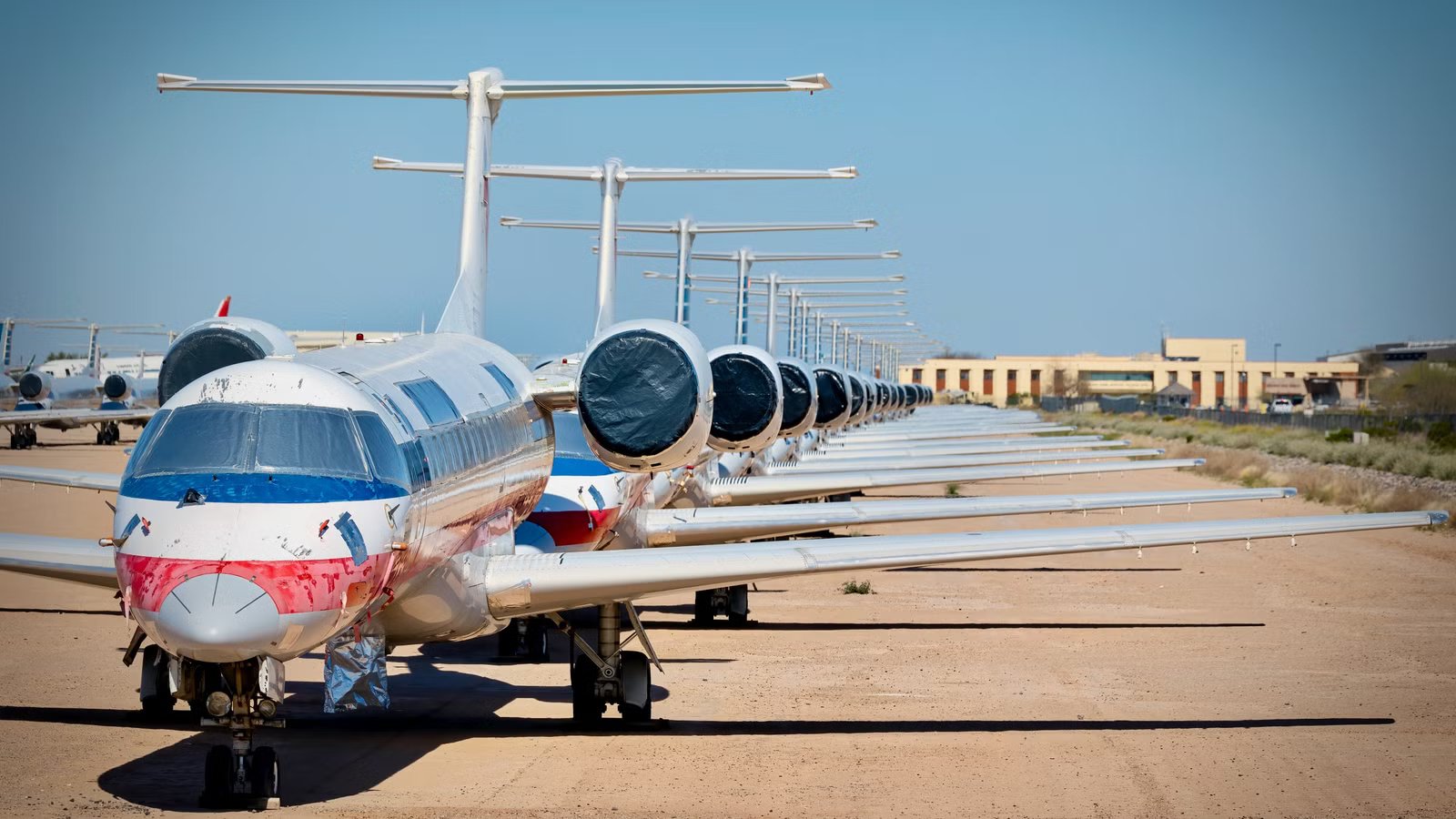
Over 1,300 new commercial aircraft were delivered in 2024 by Airbus,  Boeing, Embraer, ATR, and Comac. However, only half of those aircraft actually accounted for fleet expansion. With an average of 650 aircraft retired annually over the past decade, the other half of deliveries went to upgrading commercial fleets, replacing older aircraft that the airlines have chosen to retire.
The average age of retirement for aircraft is typically 25-30 years for passenger aircraft and 30-40 years for freighters. However, this can vary greatly between airlines according to the multitude of factors that go into their fleet management planning. So, let’s take a closer look at how airlines decide when it’s time to retire an aircraft.
Economic Factors Are The Primary Driver

Most people assume that the retirement of aircraft is based on age, or more specifically, the number of cycles or flight hours that an aircraft has undertaken. While that is certainly a factor, the retirement decision almost always comes down to basic math.
When the cost of operating an aircraft reaches a point that it exceeds the revenue the aircraft can generate (it becomes unprofitable), the aircraft will be retired. Of course, this cost/revenue balancing act is different for every airline, and several different factors go into the retirement calculation.
The Value Of The Aircraft

The value of the aircraft and how much will need to be written off is a key factor. An aircraft that is paid off or at the end of its lease is financially a lot easier to retire than one where the airline still owes a significant amount to creditors. The age of the aircraft and its resale value are, therefore, also key determinants of the value, but this is not the only area where age is a determinant (see below). Ironically, when an aircraft is fully paid off, it might gain a reprieve from the airline and have a longer operating life.
Assuming maintenance costs are still acceptable, it often makes financial sense to continue to operate an older aircraft when you no longer have to make monthly payments on it. We see this with  Delta Air Lines and its continued use of the 80 Boeing 717s in its fleet (most of them ex-AirTran). With no capital costs for the fleet, it is logical to continue using the 110-seaters as the airline slowly phases in the Airbus A220s that are replacing them.
Ongoing Maintenance Costs

Keeping those 717s in the air on an economical basis is possible because Delta has a world-class TechOps division with a long history of keeping older aircraft, like its 757s and 767s and ex-Northwest Airlines Airbus A320s, both airworthy and profitable. However, not every airline has such extensive MRO operations as Delta or the economies of scale of a large fleet, so for them, the calculations are different. As a result, the ongoing maintenance costs of an aircraft are also a primary determinant of when it will retire.
Just like the car you drive every day, as an aircraft ages and more parts need to be serviced and replaced more frequently, it reaches a tipping point where it is no longer economical to keep it flying. This is very often centered around D checks, the most extensive maintenance checks for any aircraft, which occur every six to ten years. D checks cost millions of dollars and take the aircraft out of service for up to six weeks, as Qantas explains:
“It involves comprehensive inspections and repairs of the entire aircraft. Our technicians basically dismantle the entire airplane and put it back together again. We go through every aircraft system, we remove the landing gear, take off the engines, and check and repair or replace everything. Even the cabin, we stip out everything, the seats, toilets, galleys, overhead bins, everything, so engineers can inspect the metal skin of the aircraft, inside out.”
Other Operating Costs

Of course, it’s not just maintenance costs that go into the equation of operating an aging aircraft. The other big factor is fuel efficiency. This has been a direct contributor to the widespread retirement of quad-jets globally, as far more efficient A350s and 777s have rapidly replaced the A340s and 747s that were commonplace just a decade ago.
This factor gains increasing significance when oil prices are higher and is especially important to airlines operating in highly competitive markets, as the opportunity cost of competing with less efficient aircraft is higher. Another oft-overlooked factor is the cost of refurbishing the interiors of aging aircraft. Airlines might choose to dispose of the aircraft rather than spend millions of dollars per aircraft on a retrofit. This is less of a factor today, as aircraft shortages are forcing airlines to use their fleets for longer.
A good example is  American Airlines with its 130+ A319s. With many now over 25 years old, the airline might normally be considering phasing them out, but without an easily obtainable replacement, it is instead embarking on a cabin retrofit to try and squeeze a few more years out of the aircraft.
Other Considerations

Several other factors go into the calculation of the ideal retirement time for aging aircraft. For instance, large manufacturer backlogs and recent delivery delays due to safety concerns and engine issues have made it difficult to get a ready replacement for an aging aircraft. Ideally, those American A319s could be replaced by new A220s, but the carrier would be waiting a long time, given the A220 backlog and Airbus’ suboptimal production rates for the type.
Even when an airline has replacement orders, it will likely delay the retirement of older aircraft (even when margins are razor-thin) if the network needs to demand them. For example, Lufthansa keeps operating its inefficient A340s while it awaits delivery of its A350s and long-delayed 777Xs and 787s because it needs to keep its routes to the US and Asia open.
Airlines with larger fleets and strong fleet commonality can achieve economies of scale that allow them to operate older aircraft for longer. Southwest Airlines, with its all-737 fleet, is a good example. It only retired its last 737-300 a few years ago and still operates over 340 of the 737-700 variant, most of which are 20+ years old with a much higher-than-average number of cycles.
A more recent development is the fact that some airlines will hasten the retirement of aircraft if the strategy is to up-gauge the fleet with larger aircraft. The easyJet fleet is a good example, as upgauging its massive orders for A320neo and A321neo aircraft has sped up the retirement of its A319s.
Macroeconomic Impacts Change Everything

Of course, all of these careful plans are torn up when a major macroeconomic event takes place. The bankruptcies of  United Airlines and US Airways in the aftermath of 9/11 led both airlines to remove scores of 737 Classics from their fleets, despite the aircraft being just a few years old, as they looked to reduce costs and shed debt.
|
Airlines that retired entire aircraft types during the COVID-19 pandemic |
|
|---|---|
|
Airline |
Aircraft types retired |
|
Air Canada |
767 |
|
Air France |
A340, A380, 747 |
|
Air Transat |
A310 |
|
Alaska Airlines |
A319 |
|
American Airlines |
A330, 757, 767, A330, CRJ200, E190 |
|
British Airways |
A318, B747 |
|
China Airlines |
747, E190 |
|
Delta Air Lines |
777, CRJ200, MD-88, MD-90, |
|
Iberia |
A340 |
|
KLM |
747 |
|
Qantas |
747 |
|
Singapore Airlines |
A330 |
|
Virgin Atlantic |
747 |
|
WestJet |
767 |
However, the biggest macroeconomic impact in our lifetimes was undoubtedly the COVID-19 pandemic, which accelerated aircraft retirements at nearly every major global airline. In many cases, entire aircraft types were retired, as detailed above.
What Happens To Aircraft After Retirement?

After retirement, aircraft can go in one of three different directions. Airframes that are still relatively young might enjoy a second life with another airline, either via purchase or a lessor. For example, when  Singapore Airlines chose to retire its A330s early, many were less than ten years old, and most now operate for other airlines such as Air Canada (which has 12 ex-Singapore examples), Brussels Airlines, and AirAsia.
A second fate might be a freighter conversion. More than a hundred passenger aircraft are converted into freighters each year, with the retirements of numerous 747s and 767s over the past five years proving to be historically popular with specialist freighter service providers.
More recently, there has been a surge in A330 conversions, and they are expected to surpass 767 conversions for the first time this year. Amazon Prime Air received multiple converted A330s last year, all ex-Etihad aircraft, growing its A330 converted freighter fleet to 10 aircraft at a relatively young average age of just 11 years.
Finally, if the aircraft is just too old and/or there are no viable options for a new lease of life, the aircraft is inevitably sent to a ‘boneyard’ such as Pinal County Airpark in Arizona or the Mojave Air and Space Port in California. Here, it will be broken down into parts that can be reused on other operational aircraft of the same type, with more than 90% of the remnants typically able to be recycled.